Key Takeaways
Singapore’s past is best understood through the people who worked, travelled, traded, raised families and adapted to change. These are the threads that connect an old maritime settlement with the densely lived city of today.
- Temasek grew through waterways, regional trade and seafaring communities.
- The 1819 free port brought opportunity, migration and sharp inequality.
- Kampongs, schools, workplaces and family networks shaped colonial life.
- War and occupation left memories that influenced post-war politics.
- Modern Singapore was built through housing, public services and shared civic experiences.
Before the skyline: Singapore as a small island of traders and fishermen
Long before towers reflected in Marina Bay, the island was a place of water, forest paths and small settlements. Its history began not with a single grand foundation, but with people moving between shorelines, rivers and the busy sea routes of the region. To understand the history of singapore, it helps to begin with ordinary routines: hauling nets, repairing boats, exchanging goods and reading the tides.
The communities living around Temasek’s waterways
Temasek, often understood as “sea town”, was connected to the wider Malay world by water. People settled around rivers and inlets where boats could be pulled ashore and goods passed from one vessel to another. Fish, forest produce, ceramics, cloth and foodstuffs moved through these modest communities, giving the island a life that was practical rather than monumental.
The waterways also shaped social ties. A household might depend on fishing in one season, small-scale trading in another, and work for a visiting vessel when circumstances demanded it. Families lived close to the places where they worked, so the shoreline was at once market, workplace, transport route and meeting ground.
Malay rulers, regional connections and the island’s changing names
The island’s names reflect the changing political and commercial worlds around it. Temasek sat within networks influenced by regional powers, while Singapura, or “Lion City”, belonged to a later layer of memory and legend. The names do not describe separate islands so much as different ways of placing the same island within Southeast Asia.
Rulers, merchants and sailors rarely viewed the island in isolation. Its usefulness came from its position near the southern entrance to the Strait of Malacca, where ships crossed between the Indian Ocean and the South China Sea. A short account of the early history of Singapore offers a helpful overview of these older names, empires and trading connections, though the lives of most residents remain less clearly recorded.
Orang Laut seafarers and the rhythms of maritime life
The Orang Laut, or sea people, were central to the maritime world of the southern Malay region. Their knowledge of channels, reefs, currents and weather made them valuable guides, traders and fishing communities. Their lives were organised by the sea’s movements, with boats serving as homes, workplaces and links to neighbouring islands.
For communities on land, these seafarers brought news as well as goods. A boat arriving from across the straits could carry information about prices, political changes or distant storms. Such connections made the island feel larger than its shoreline, even when daily life remained physically close to mangroves, mudflats and wooden jetties.
What archaeology reveals about everyday trade and settlement
Archaeology has supplied details that written accounts often overlook. Pottery fragments, beads, coins and traces of structures suggest that the island participated in long-distance exchange well before the British arrived. They also show that trade was not only a matter for rulers; it depended on carriers, cooks, repairers, market sellers and households that turned imported objects into useful parts of daily life.
Objects can be quietly revealing. A ceramic vessel points to a route, but it also raises questions about who unpacked it, what it held and whether it was used in a home or sold onwards. That attention to small evidence is close to the spirit of neighbourhood stories, where a place becomes legible through objects, routines and remembered voices rather than famous monuments alone.
1819 and after: How a free port changed ordinary lives
The arrival of the British trading post in 1819 altered the island’s scale and direction. A free port attracted ships, capital and labour, but it also created pressure on land, housing and food supplies. The story is often told through Stamford Raffles, yet its consequences were felt most sharply by the people who unloaded cargo, cooked meals, carried messages and made new homes in unfamiliar streets.
Stamford Raffles and the making of a British trading post
Stamford Raffles negotiated an agreement with the Sultan of Johor that enabled the British to establish a trading post on the island. Its free-port policy encouraged merchants to call without the restrictions found elsewhere, and Singapore soon became a busy node in regional commerce. The plan was strategic, but the town that emerged was made by thousands of people whose names seldom appear in official accounts.
Government buildings and maps gave the new settlement an administrative shape. Around them grew wharves, markets, lodging houses and workshops. A policy intended to attract trade therefore changed the rhythm of local life, drawing people towards the river and the new commercial centre.
Shopkeepers, dockworkers and boatmen in a rapidly growing port
Growth created many kinds of work. Shopkeepers supplied rice, cloth and household goods; dockworkers shifted cargo in exhausting heat; boatmen moved people and freight along the river. Small businesses depended on trust, credit and family labour, while casual workers faced uncertain wages and long days.
The port’s activity was visible in its sounds: shouted instructions, creaking hulls, handcarts over uneven ground and the clatter of workshops. It was also present in less visible forms, such as debt, illness and the constant need to find a room near work. The free port offered mobility, but it did not offer security equally.
Migration from China, India and the Malay Archipelago
People arrived from southern China, the Indian subcontinent and across the Malay Archipelago, joining communities already rooted in the region. Some came temporarily, hoping to earn enough to return home; others settled, married and built businesses. Migration brought languages, religious practices, foods and systems of mutual aid that became part of the town’s everyday character.
These communities were never sealed off from one another. Markets, docks and shared workplaces created contact, while intermarriage and neighbourhood exchange blurred official categories. Still, colonial administration frequently classified people by race and origin, turning a fluid social world into a more rigid map.
Crowded streets, clan networks and the unequal colonial city
The new town was crowded, and its advantages were unevenly distributed. Wealthier merchants could secure larger premises and better access to credit, while labourers often lived in cramped rooms close to the places where they worked. Clan associations, temples, mosques and mutual-aid societies helped newcomers find jobs, lodging and support when formal institutions offered little.
The colonial city therefore combined energy with vulnerability. Its streets connected people to opportunity, but they also exposed residents to fires, disease and exploitation. The contrast between commercial confidence and household insecurity would remain a recurring feature of Singapore’s urban story.
Building a home in a divided colonial society
A port can grow quickly without becoming an easy place to live. Families had to make homes in kampongs, shophouses and rented rooms while navigating rules that divided the population into administrative communities. Daily life was shaped by practical choices: where to collect water, how far to walk to work, which school a child could attend and who might help during illness.
The colonial city was not simply a backdrop to history. It was an active force, arranging people’s access to land, work, education and public services. Yet residents also made their own geographies through friendships, associations, religious institutions and the repeated habits of neighbourhood life.
Kampongs, shophouses and the practical geography of daily life
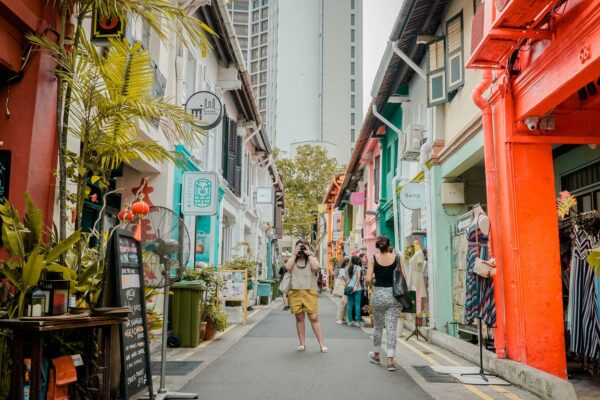
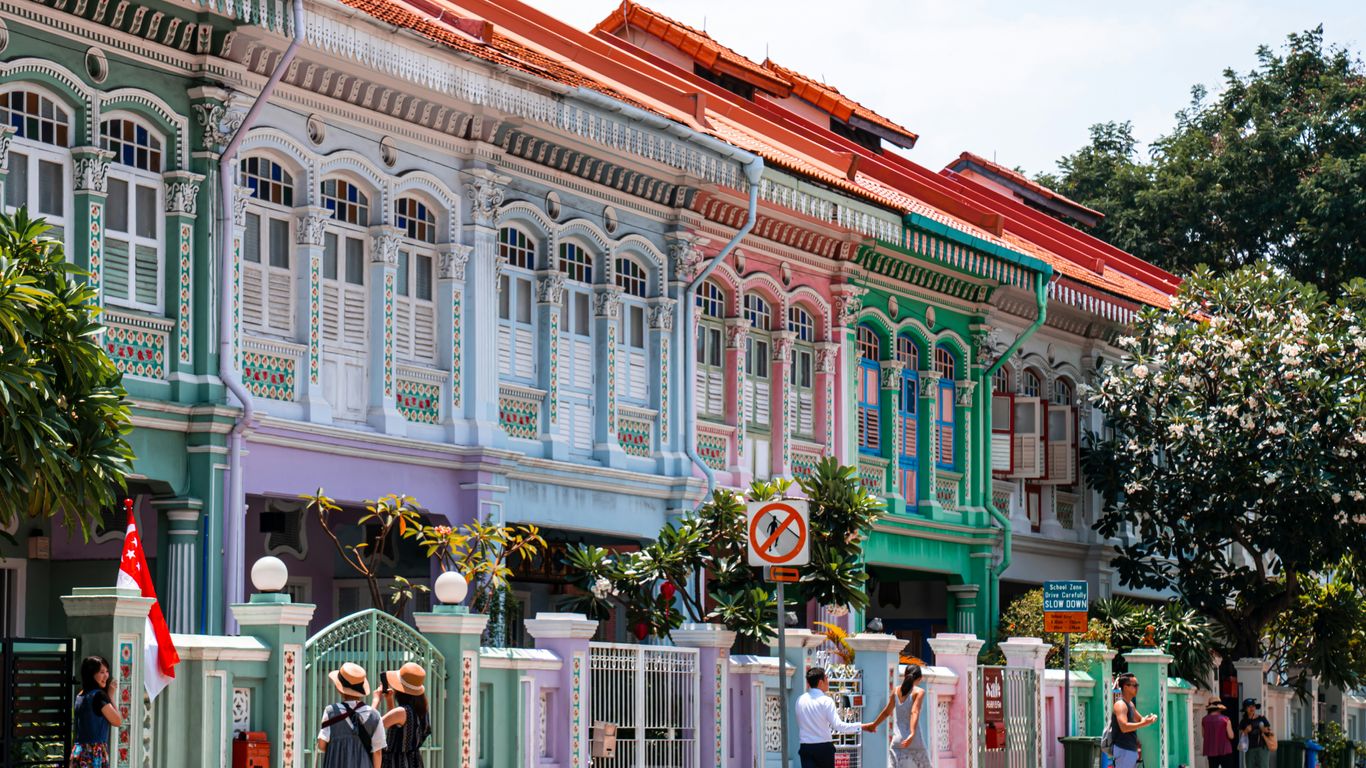
Kampongs offered forms of community that were often absent from formal plans. Houses might stand beside gardens, workshops or shared paths, with neighbours borrowing tools and keeping an eye on children. Shophouses combined living and working in narrow urban plots, placing family life above or behind a business open to the street.
The arrangement was demanding but adaptable. A front room could become a shop, a kitchen could serve several generations, and a back lane could carry news as efficiently as a newspaper. These spaces remind historians that housing is not only about buildings; it is also about the relationships those buildings make possible.
Samsui women, amahs and other overlooked workers
Samsui women, recognisable by their red head coverings, undertook hard construction work and sent earnings to families or saved for later life. Amahs worked in domestic service, caring for children and managing households while remaining largely invisible in formal histories. Washerwomen, market sellers, stevedores and food vendors similarly sustained the city without receiving much public recognition.
Their work reveals how urban development depended on labour that was physically demanding and socially undervalued. A road, house or prosperous household could rest on the effort of people whose own security was fragile. Remembering them changes the emphasis of colonial history from administrators and merchants to the workers who made the city function.
Schools, newspapers and the growth of new political ideas
Schools and newspapers widened the ways people imagined their lives. Literacy allowed readers to follow debates about labour, language, empire and reform, while student groups created spaces for discussion beyond the family or workplace. Newspapers in different languages connected local events with political movements across Asia.
Education did not produce one shared political view. It encouraged competing ideas about class, race, citizenship and the future of the colony. But it did make public argument more common, giving ordinary residents new ways to question decisions that had once seemed remote and unavoidable.
Public health, poverty and the struggle for better living conditions
Overcrowding made illness a constant concern. Poor drainage, limited sanitation and unsafe water could turn a neighbourhood problem into a wider outbreak, while low wages made it difficult for families to move to healthier accommodation. Public-health campaigns helped, but official measures often arrived unevenly and could feel intrusive to the people they were meant to protect.
Residents themselves also pushed for change through associations, petitions and local cooperation. Their demands were practical: cleaner lanes, safer housing, affordable food and access to medical care. The history of reform is therefore not only a story of government policy; it is also a record of people insisting that ordinary living conditions deserved attention.
War, occupation and survival under Japan
The Japanese invasion shattered the confidence attached to British rule. Singapore fell in February 1942, and the occupation that followed brought violence, surveillance, shortages and profound uncertainty. For families, history was no longer an argument about policy or identity; it was a question of finding food, protecting relatives and surviving another day.
The war years also altered expectations. The supposed strength of the colonial power had proved fragile, while local people had endured the occupation largely through their own resourcefulness and networks. Those experiences would shape post-war demands for dignity and political control.
The fall of Singapore in 1942 and the shock of defeat
The surrender of British forces was a psychological rupture. Singapore had been presented as a major imperial fortress, yet its defences could not prevent Japanese forces advancing down the peninsula. Civilians confronted unfamiliar troops, abrupt changes in authority and rumours that travelled faster than reliable news.
The defeat weakened the belief that colonial rule was permanent. People who had been taught to trust imperial protection saw its limits at close range. The shock did not erase fear, but it opened a space in which new questions about self-government and political responsibility could be asked.
Food shortages, fear and adapting to a new regime
Food became central to every household calculation. Rice and other staples were scarce, prices rose, and families relied on gardens, bartering and complicated journeys to find supplies. The occupation authorities introduced new rules and currency, while informers and punishment made even casual conversation risky.
Adaptation was rarely heroic in the grand sense. It meant stretching a meal, repairing an old garment, hiding useful goods and deciding whom to trust. Survival often depended on small acts of cooperation between neighbours who might otherwise have remained strangers.
Families separated by violence, imprisonment and forced labour
Arrests, executions, internment and forced labour tore through family life. Men could disappear into camps or work sites, while women and children carried on with little information. Some people were separated by military service, flight or evacuation; others never returned.
The effects lasted beyond 1945. A family might preserve a name, photograph or fragment of correspondence without being able to reconstruct the whole story. Silence could be a form of protection, especially when memories involved shame, fear or the loss of people whose fate was never confirmed.
How wartime memories shaped post-war expectations
After liberation, many residents expected more than a restoration of the old order. The war had shown that colonial power could fail and that local communities had carried much of the burden of survival. People wanted better wages, safer housing and a meaningful say in how the island was governed.
Wartime memory was not uniform. Some remembered hunger, others imprisonment, collaboration or resistance, and many remembered several things at once. Even so, the occupation helped create a broad post-war impatience with being treated as subjects rather than citizens.
From colony to self-government: Ordinary people enter politics
Post-war politics grew from workplaces, schools, newspapers and neighbourhood organisations. The question was not simply which party should govern, but who had the right to shape the island’s future. Trade unionists, students, teachers, clerks and small business owners became more visible in public life.
Political change was uneven and sometimes turbulent. It involved arguments over class, language, colonial authority and the relationship between Singapore and the wider Malay world. Ordinary people entered politics because decisions about wages, education and housing had become impossible to separate from decisions about power.
Trade unions, student groups and the demand for a greater voice
Trade unions gave workers a structure for challenging low pay and poor conditions, while student groups debated education and anti-colonial politics. Strikes and demonstrations could disrupt daily life, but they also made private grievances public. The demand for representation grew alongside demands for social protection.
Not every movement agreed on methods or goals. Some sought gradual constitutional change; others imagined a more radical transformation. Their differences mattered, yet together they showed that political life had moved beyond the small circle of colonial officials and established commercial leaders.
The path from self-government to merger with Malaysia
Internal self-government in 1959 marked a major step, but it did not settle the question of Singapore’s long-term position. Merger with Malaysia was presented by its supporters as a route to security and a larger economic framework, while opponents worried about political control, communal tensions and competing visions of society.
The debate reached into homes, workplaces and coffee shops. It was discussed through speeches and newspapers, but also through family arguments and everyday calculations about jobs and prices. The decision was ultimately shaped by forces larger than any one household, though households would bear its consequences.
Separation in 1965 and the uncertainty of a new nation
Singapore became an independent state in 1965 after separation from Malaysia. The moment carried little of the effortless certainty found in later national stories. There were concerns about defence, employment, water, housing and the viability of a small island without natural resources.
The new nation had to build institutions quickly while persuading people from different backgrounds that they shared a future. Its early decades brought strict decisions and rapid development, but also a continuing effort to define what independence meant in ordinary life.
Language, identity and the challenge of building common ground
Language policy became one way of managing a diverse population. English was used widely in administration and education, while Malay, Mandarin and Tamil remained important parts of cultural and family life. The arrangement created opportunities for communication, but it also produced losses, tensions and difficult choices between generations.
Identity was never only a matter of official policy. It was heard in accents, carried in recipes and practised in religious festivals, schools and workplaces. A nation could encourage common ground without making people’s inherited worlds disappear, though balancing those aims has never been simple.
Housing, work and the making of modern Singapore
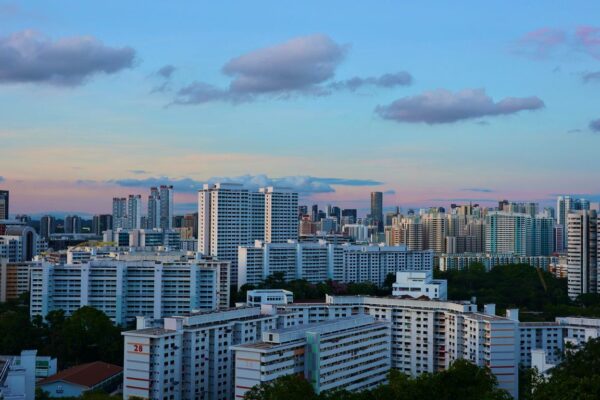
Modern Singapore was built through an enormous transformation of the everyday environment. Kampongs gave way to planned estates, factories and transport links; new schools and public services changed the shape of childhood; and families adjusted to high-rise living. The transformation improved many lives, but it also displaced familiar landscapes and social routines.
The state played a powerful role in directing this change. Public housing, industrial policy and urban planning were treated as foundations of national survival. Their effects are easiest to see not in official statistics but in the ordinary timetable of a household: where someone sleeps, works, studies, shops and meets neighbours.
Public housing and the transformation of kampong life
The Housing and Development Board built large numbers of flats, offering many families more reliable sanitation, electricity and access to services. Moving into a flat could mean a safer home and a shorter route to school, but it could also mean leaving a close-knit kampong where doors remained open and neighbours knew one another’s histories.
Relocation changed community life rather than simply ending it. Families carried furniture, recipes, religious practices and habits of mutual help into new estates. Corridors, lifts and void decks became different kinds of shared spaces, with their own patterns of sociability.
Factory workers, civil servants and the new industrial economy
Industrialisation brought factory work to an expanding workforce. Electronics, manufacturing and related services created jobs for people who had previously depended on casual labour, domestic service or small trade. Civil servants also became part of a growing administrative system that delivered housing, education and public health on a national scale.
The new economy demanded discipline and new skills. Workers adjusted to shifts, machinery and formal contracts, while families reorganised childcare around working hours. A wage from a factory or government office could offer greater predictability, even as it tied daily life to the demands of a rapidly changing economy.
National service, schools and shared civic experiences
National service brought young men from different neighbourhoods and language backgrounds into a common institution. Schools likewise became places where children encountered national narratives, shared rituals and classmates whose family histories differed from their own. These experiences helped build a common civic identity, though they did not remove every social or economic difference.
The shared experience was often practical rather than sentimental: learning commands, travelling across the island, joining a school activity or preparing for examinations. Such routines gave the young nation a vocabulary of belonging that was repeated across generations.
How sanitation, transport and urban planning changed daily routines
Clean water, improved drains, reliable buses and expanding roads altered the basic rhythm of the city. A household could spend less time collecting water or travelling between distant parts of the island, while markets and schools became easier to reach. Planned neighbourhoods also placed clinics, shops and playgrounds within more predictable distances.
The change can be mapped through a typical day, from a morning bus to a school corridor, a factory canteen or a hawker centre. For readers who want to connect broad history with the details of streets and working places, book a walk can be a useful way to encounter those layers at ground level. Modernisation was not an abstract process; it was felt in tired feet, saved minutes and new forms of convenience.
Singapore today: Prosperity, memory and lives still in transition
Singapore today carries the marks of every earlier period: maritime exchange, migration, colonial planning, war, political struggle and rapid development. Its prosperity has created opportunities that earlier generations could scarcely imagine, but it has also brought high costs, ageing households and anxiety about whether familiar places can endure.
The city remains easiest to understand through ordinary activity. A hawker opening before dawn, an older resident sorting photographs or a family switching between languages all reveals how history continues in the present. Living heritage is not frozen; it is negotiated each time a place is repaired, renamed, redeveloped or remembered.
Families shaped by migration across generations
Migration remains part of family life, whether remembered through an ancestor’s arrival from southern China, India or the Malay Archipelago, or through a more recent move for work and study. Stories often change as they pass between generations. A difficult journey may become a proud family legend, while an old language or occupation may gradually fade.
Family archives hold these shifts in small forms: a recipe written in a different script, a photograph taken outside a vanished shop or a letter kept in a drawer. Singapore Heritage supports community-centred ways of preserving such memories, with attention to consent, credit and access rather than treating personal history as an anonymous resource.
Hawkers, small businesses and the culture of everyday work
Hawkers and small shopkeepers continue traditions of skill, speed and adaptation. Their work is shaped by rent, suppliers, regular customers and long hours, not only by the dishes or objects that visitors notice. A kopitiam table, enamel cup or handwritten order slip can carry the history of migration and changing work patterns.
The city’s old trades also show how knowledge lives in hands and habits. Repairers, bakers, stallholders and makers learn through repetition and observation, often adjusting inherited methods to new materials and customers. A kopitiam object archive makes this point vividly: everyday items can be a working record of social life.
Ageing, inequality and the pressures of a high-cost city
Prosperity has not made everyone equally secure. Older residents may face isolation, rising costs or the difficulty of remaining near familiar support networks, while younger households weigh housing, care and work demands. Migrant workers and low-wage employees contribute substantially to the city yet can remain vulnerable to sudden financial pressure.
These realities complicate any simple account of success. The modern city offers safety and opportunity, but its pace can make people feel that they are always adjusting. Public policy matters, but so do neighbourhood relationships, accessible services and the willingness to see whose labour sustains convenience.
Preserving neighbourhoods and memories amid constant redevelopment
Redevelopment can improve buildings and infrastructure while erasing the settings in which memories formed. A market may survive in a new structure, yet lose the informal relationships that once made it feel like a neighbourhood. Conversely, an old building can remain standing without the people, trades or routines that gave it meaning.
Preservation therefore works best when it includes residents and working communities. It may involve recording a shopkeeper’s knowledge, walking a former route, keeping a food practice alive or making a carefully researched object. Singapore Heritage connects story-led neighbourhood walks with gifts that help people carry a particular place and its memories home.
A useful way to read the present is to notice what has changed and what has been carried forward. The city’s history sits in the distance between an old sign and a new façade, in the route a bus now takes, and in the family story told over a shared meal. Everyday lives remain the clearest map of how Singapore became what it is.
Experience Singapore’s Living History
Singapore’s past becomes more vivid when it is encountered through streets, foodways, objects and the people who still know their stories. Singapore Heritage creates small-group heritage walks and researched story gifts that invite residents and visitors to spend time with those local layers. Plan a heritage tour for a slower, more attentive way to meet the island beyond its most familiar views.
Conclusion
The history of Singapore is not only a sequence of ports, rulers, wars and political milestones. It is also the record of boatmen, domestic workers, schoolchildren, factory hands, hawkers, migrants and families who made homes through repeated acts of work and adaptation. Their lives give the island’s large transformations a human scale, and they continue to shape how the city remembers itself.
Frequently Asked Questions
When did Singapore first become an important trading settlement?
Singapore was part of regional maritime networks long before the modern British port, with evidence of significant settlement and trade by the medieval period. Its position near the Strait of Malacca helped connect it to wider movements of people and goods.
What was Singapore called before it became a British trading post?
Temasek is an older name commonly associated with the island, while Singapura, meaning “Lion City”, belongs to another important layer of historical tradition. Different names reflect changing political, cultural and linguistic contexts.
Why did so many migrants come to Singapore in the nineteenth century?
The free port created demand for labour, trade and services, attracting people from southern China, India and the Malay Archipelago. Some intended to return home, while others settled and formed families and businesses.
How did colonial rule affect ordinary residents?
Colonial rule created commercial opportunities but also imposed unequal access to housing, work, education and political power. Residents built their own support networks through families, religious institutions, clan associations, unions and neighbourhood groups.
What was the impact of the Japanese Occupation?
The occupation brought violence, imprisonment, forced labour, fear and severe shortages. It also weakened confidence in permanent British authority and influenced post-war demands for better conditions and greater self-government.
Why was public housing so significant after independence?
Public housing provided many families with more dependable homes, sanitation, electricity and access to services. It also transformed social geography, as residents moved from kampongs and crowded urban quarters into planned high-rise estates.
How can people understand Singapore’s history today?
They can visit museums and historic sites, but they can also pay attention to markets, hawker centres, shophouses, estates, family archives and working neighbourhoods. Conversations with residents and respectful heritage walks often reveal how the past continues in ordinary routines.