Food, repair workshops and working memory sit side by side in one of Singapore’s most layered everyday places.
Key summary
- Alexandra Village was planned so motor repair, housing, shops and everyday food could coexist.
- Work began in 1978 on Singapore’s first motor-repair “village”.
- Today, nine blocks of single-storey terrace workshops stand at 1001–1010 Bukit Merah Lane.
- Eat first, then walk the public edges to see how lunch follows the rhythm of repair work.
- Do not obstruct businesses, enter workshops uninvited or photograph workers without permission.
- The story is about recognising skilled work and practical knowledge while they remain in use.

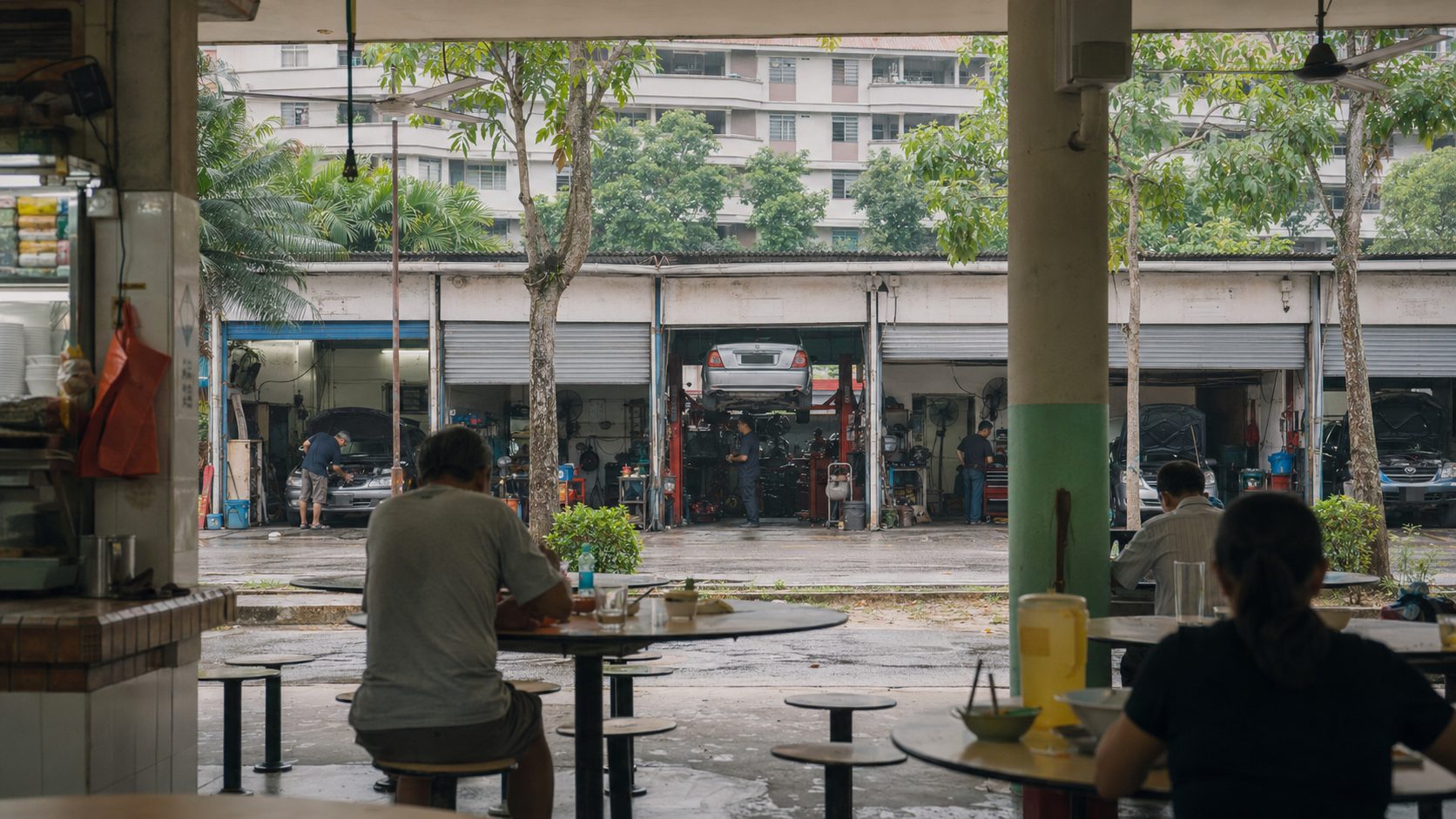
Image 1: Food in the foreground, repair work across the lane.
Lunch within earshot of a workshop
Sit near the open edge of Alexandra Village Food Centre and lunch arrives with an unusual background. A spoon touches a bowl. A drinks seller calls an order. Beyond the tables, a roller shutter is open and a car is raised above a workshop floor. The sounds do not cancel one another. They form the working register of the place.
Alexandra Village should not be approached as a list of famous dishes followed by separate historic facts. Its significance is spatial. Food, repair and residential life were put close together, and that relationship can still be read at walking speed. A mechanic can cross for coffee; a customer waiting for a vehicle can eat nearby.
The food centre is officially listed as Block 120 Bukit Merah Lane Food Centre, also known as Alexandra Village Food Centre. Around it, workshop doors reveal lifts, tyres, tools and shelves arranged for daily use. These are not museum displays; they are evidence of work continuing in real time.
Heritage may be present before anyone labels it. Here, it survives in a route taken at noon, a tool returned to the same drawer and workers moving from a repair bay to a hawker table.
A village deliberately built for repair
According to the National Library Board’s Singapore Infopedia history of Alexandra, work started in 1978 on Singapore’s first motor-repair “village”. The site had previously been a kampong associated in local memory with British servicemen. The new development combined workshops and shophouses selling motor accessories with flats, eating houses and food stalls for residents and workers.
Food was not an ornamental addition to the industrial area; eating places were part of its operating system. Repair businesses needed vehicle access, suppliers, customers and workers. Those people needed affordable meals and places to pause. Nearby housing made Alexandra Village both a productive landscape and an everyday neighbourhood.
The industrial component remains legible. JTC’s current Alexandra Village Industrial Estate listing identifies nine blocks of single-storey terrace workshops at 1001–1010 Bukit Merah Lane. The units provide ground-floor and front-of-house vehicular access and are designated for motor-related trades. JTC also describes Alexandra Village Food Centre and ABC Brickworks Hawker Centre as neighbouring amenities rather than unrelated destinations.
The official language is functional—access, automotive use and proximity—but those features explain the precinct’s character. It was made to shorten distances between repairing, eating, buying and living.
The old trade is still a present-tense business
Calling motor repair an “old trade” can make the workshops sound obsolete. Vehicles, diagnostics, parts supply and customer expectations have changed. What persists is not a frozen technique but the ability to locate a fault, judge wear and explain a repair.
Some knowledge is written in manuals or displayed by a machine. Other knowledge is embodied: the pressure used on a fitting, the sound distinguishing one vibration from another, or the sequence of components laid out for reassembly. A workbench can hold a memory system, with frequently used tools kept within reach.
Not every workshop is automatically “heritage”, and visitors are not entitled to enter it. The point is that skilled work deserves attention alongside architecture and food. A place can lose meaning even while its buildings remain if its trade and working relationships disappear.

Image 2: Repair knowledge is carried through tools, touch and repetition.
A hawker lunch shaped by working time
Singapore’s hawker culture was inscribed in 2020 as the country’s first element on UNESCO’s Representative List of the Intangible Cultural Heritage of Humanity. The National Heritage Board’s account of the inscription emphasises community participation, continued practice and transmission. Alexandra Village adds a useful local question: what does a “community dining room” look like when part of that community is an industrial workforce?
It looks practical. Businesses break at different times. A longer meal may depend on parts arriving or a customer returning. Regular diners learn which tables receive the breeze and which stalls close on particular days; hawkers learn familiar orders and the rush created by nearby workplaces.
The foodway is larger than any “must-eat” dish. Menus and operators change, so no article should promise that a stall will be open without checking. The durable story is affordable choice, shared tables and eating close to work.

Image 3: A working lunch understood through its setting, not as an isolated food photograph.
Walk the relationship, not just the landmarks
Allow 60 to 90 minutes, including a meal. This route follows public paths and does not grant entry to industrial premises.
Stop 1: Alexandra Village Food Centre
Begin at Block 120 Bukit Merah Lane 1. Walk once around the public edge and notice which sides face housing, shops or industrial activity. From your table, listen for transitions between cooking, conversation, delivery and mechanical work. Ask what the stalls reveal about the people eating here and when they arrive.
Stop 2: The threshold between lunch and labour
Leave by a public exit facing the workshop landscape. Look for movement between uses: a worker carrying a drink, a customer returning to a vehicle or supplies being unloaded. Stay on the pavement and clear of manoeuvring vehicles.
Stop 3: The terrace-workshop blocks
Continue towards 1001–1010 Bukit Merah Lane. JTC describes nine blocks of single-storey workshops designed for ground-floor access. From public space, compare the repeated building frame with the shutters, trolleys, racks and benches that make each unit distinct.
An open shutter is not an invitation. For a closer look or photograph, introduce yourself, explain SingaporeHeritage.sg, state where the material may appear and accept “no” immediately. Never record registration numbers, documents, faces or proprietary processes without approval.
Stop 4: Read the wider service landscape
On the return loop, notice motor-accessory shops, food businesses, parking and housing. If time allows, extend towards Queensway Shopping Centre or ABC Brickworks Hawker Centre. The wider area shows Alexandra as a network of industrial, retail and residential layers rather than an isolated “heritage village”.

Image 4: Walk along public edges and remain clear of active work areas.
What to notice
Look for systems rather than picturesque clutter. How are tools stored? Where does a completed job wait? Does the workshop communicate through tags, apps, memory or all three? How does rain change the usable edge of a unit?
Apply the same questions to lunch. How are orders called and collected? Which objects organise the table? What changes between breakfast and afternoon? A foodway is made from movements and relationships as much as recipes.
Both hawking and repair rely on preparation, speed, accuracy and reputations built through repeated encounters. Both are physically demanding. Both are misrepresented when outsiders value an “authentic atmosphere” while ignoring rent, succession, long hours and business viability.
Community memory requires permission and return
This draft contains no invented interview or attributed personal memory. A field version should add community voices only through a respectful consent trail.
Before recording, explain the project, audience and whether material may also be used in tours, social media, products or exhibitions. Interview consent does not automatically cover a portrait or merchandise. Record the contributor’s preferred credit, approved uses, off-record topics, permission date and correction contact.
Send edited quotations back for review when practical, credit contributors as agreed and provide the finished page. If a story generates a paid walk, gift or corporate programme, state how participating people and communities benefit.
My Community’s guiding principles emphasise collaboration, accessibility, long-term relationships and community-centrism. Here, that means treating workers as knowledge holders and partners—not scenery for a visitor experience.
Practical visit information
Starting point: Alexandra Village Food Centre, Block 120 Bukit Merah Lane 1, Singapore 150120. The food centre appears on the NEA list as Block 120 Bukit Merah Lane Food Centre / Alexandra Village Food Centre.
Workshop area: Alexandra Village Industrial Estate, 1001–1010 Bukit Merah Lane.
Public transport: JTC lists buses 14, 123, 147, 153, 196, 197, 198, 855 and 961, and estimates Queenstown MRT at a 15-minute walk or five-minute bus ride. Check a live journey planner because routes can change.
Best visiting approach: Choose a weekday outside the lunch peak for observation. Hours vary, so verify any named business before making a special trip.
Safety and courtesy: Use public pavements, watch for reversing vehicles, keep children close, do not touch tools or parts, and ask before taking a close photograph. The industrial estate is an active workplace, not a pedestrianised attraction.
Key takeaways
- Alexandra Village’s heritage lies in the designed proximity of repair, food, housing and retail.
- The 1978 motor-repair “village” remains visible through its single-storey workshop form and working uses.
- A hawker lunch here is part of an industrial daily rhythm, not separate from it.
- Skilled repair knowledge can be carried in sound, touch, routine, language and workshop organisation.
- Visitors should observe from public space and seek explicit permission for access, interviews or images.
- Preservation should support viable living practices and fair community participation, not only attractive storytelling.
Frequently asked questions
1. What is Alexandra Village best known for?
Alexandra Village is widely known for its food centre and its concentration of motor-related workshops. What makes it especially interesting is that these uses were planned close together. The precinct also sits near ABC Brickworks Hawker Centre, Queensway Shopping Centre and IKEA Alexandra. For a heritage visitor, its value is not one landmark but the relationship among food, repair, retail, housing and movement. It remains an active everyday district, so the most rewarding visit is observant and respectful rather than organised like a museum tour.
2. When was the motor-repair village developed?
The National Library Board records that work started in 1978 on Alexandra Village, described as Singapore’s first motor-repair “village”. It was developed on a former kampong site and included workshops, motor-accessory shophouses, flats, eating houses and food stalls. That mix helps explain why the precinct still feels different from a self-contained industrial park. The history should be understood as redevelopment and industrial planning, not as the survival of an unchanged kampong.
3. Where exactly are the workshops?
JTC lists Alexandra Village Industrial Estate at 1001–1010 Bukit Merah Lane. It comprises nine blocks of single-storey terrace workshops intended for motor-related industries. Because businesses and tenancy can change, use the estate address rather than relying on an old list of workshop names. The safest heritage route follows public pavements around the blocks and the food centre. Do not enter a bay, yard or marked work area unless a business has invited you.
4. Is Alexandra Village Food Centre the same as Block 120 Bukit Merah Lane Food Centre?
Yes. Official materials identify the centre as Block 120 Bukit Merah Lane Food Centre and also call it Alexandra Village Food Centre. It is at Block 120 Bukit Merah Lane 1. Individual stall schedules differ, and closures can be temporary or permanent, so check current information if you are travelling for one particular vendor. For this story, the food centre is the starting point from which to understand the surrounding working landscape.
5. What should I eat at Alexandra Village?
Choose a dish that suits your dietary needs, budget and the stalls actually open that day. This article intentionally avoids promising a definitive “best” stall because operators, hours and queues change, and a heritage page should not turn the precinct into a fixed ranking. A simple local meal and drink are enough for the route. Pay attention to ordering, collection, table use and the flow of workers at different times; those everyday practices are part of the foodway.
6. What is the best time to visit?
A weekday morning or mid-afternoon usually makes it easier to observe public spaces without adding to the lunch crowd, but it may not coincide with every stall or workshop’s operating hours. If eating is central to your visit, arrive before the main lunch rush and expect popular stalls to have their own rest days. Avoid touring during heavy rain or at dusk if reduced visibility makes vehicle movement harder to judge. Always prioritise the needs of businesses and workers over photography.
7. How long does the suggested walk take?
Allow 60 to 90 minutes, including a meal and a slow loop along public paths. The core workshop-and-food relationship can be seen over a short distance, so there is no need to rush or cover every block. An extension to ABC Brickworks Hawker Centre or the Queensway Shopping Centre area will take longer. Use a live map for navigation, remain alert at service lanes and shorten the route for children, older visitors or anyone uncomfortable around active vehicle traffic.
8. Can visitors enter the workshops?
Not without permission. These are operating businesses handling customer vehicles, equipment, parts and records. An open roller shutter provides ventilation and access; it does not make the premises a public exhibit. If a workshop offers an organised visit, follow its safety instructions and agreed boundaries. Otherwise, observe only from public space. SingaporeHeritage.sg should arrange any formal workshop stop in advance, define the group size and photography rules, and compensate hosts where their time or expertise forms part of a paid experience.
9. May I photograph workers and workshop interiors?
Ask first, even when taking a photograph from a public path. Explain who you are, what the image will show and where it may be published. Obtain separate approval for identifiable faces, interviews and commercial uses. Avoid licence plates, invoices, computer screens, telephone numbers, customer details and proprietary procedures. A refusal requires no justification and should be accepted immediately. Wide architectural views without identifiable people are generally less intrusive, but courtesy remains essential in a close working environment.
10. Is the route suitable for children?
It can be, with close adult supervision. Children should remain on pavements, never enter a work bay, and stay well away from moving or reversing vehicles, lifts, tools, liquids and parts. A shorter activity can focus on comparing objects used to organise work: trays and order tokens at the food centre, then trolleys and labelled storage viewed from a safe distance. Schools should conduct a prior risk assessment and arrange any interaction with a workshop or hawker in advance.
11. Why treat motor repair as heritage?
Heritage includes living knowledge and social practice, not only old buildings. Motor repair involves diagnosis, manual skill, technical language, supplier networks, trust and knowledge passed through work. The trade also reveals how Singapore planned space for small industry and supported it with food, housing and transport. Calling it heritage does not mean resisting every technological change. It means documenting how skills and relationships evolve, and recognising the people who sustain them before their experience disappears from the public record.
12. How can I contribute an Alexandra Village memory?
Share a specific memory rather than a general statement: the workshop or stall, an approximate year, the object involved, who was present and why the moment mattered. Include only photographs you own or have permission to reproduce. State how you want to be credited and whether SingaporeHeritage.sg may contact you for clarification. Submissions should be reviewed with contributors before publication, especially when they identify another person or business. Use the Submit a Memory page to begin.
Related reading and next steps
- Explore more Foodways and Old Trades stories.
- See upcoming heritage walks and tour-plus-gift experiences.
- Carry the route home with the Memory Map Print.
Add your memory to the route
Did you repair a first car here, work in one of the workshop blocks, eat lunch here between jobs or grow up nearby? Submit your Alexandra Village memory and help document the people, objects and routines behind the place.
Source credits
- National Library Board, “Alexandra,” Singapore Infopedia.
- JTC, Alexandra Village Industrial Estate, current property and access information.
- National Heritage Board, Hawker Culture in Singapore.
- National Environment Agency, list identifying Block 120 Bukit Merah Lane Food Centre as Alexandra Village Food Centre.
- My Community, Guiding Principles.