A first-timer’s guide to night heritage, memory, respect and the strange intimacy of walking through a historic cemetery.
Key summary
- Bukit Brown Municipal Cemetery opened on 1 January 1922 and closed to burials in 1973, when it contained about 100,000 tombs.
- It was Singapore’s first Chinese municipal cemetery and accepted burials across dialect, surname and clan affiliations.
- My Community Festival’s 2025 programme included a two-hour, 9 p.m. “After Hours @ My Bukit Brown” walk led by Andrew Lin.
- Darkness changes how people read the site: torchlight isolates carvings, sound becomes more noticeable and a group moves at the pace of its least confident walker.
- A night visit should be an organised, currently confirmed guided walk—not a solo paranormal adventure.
- Tombs remain family and ritual spaces. Do not step on them, move offerings, clear vegetation or photograph worshippers without permission.
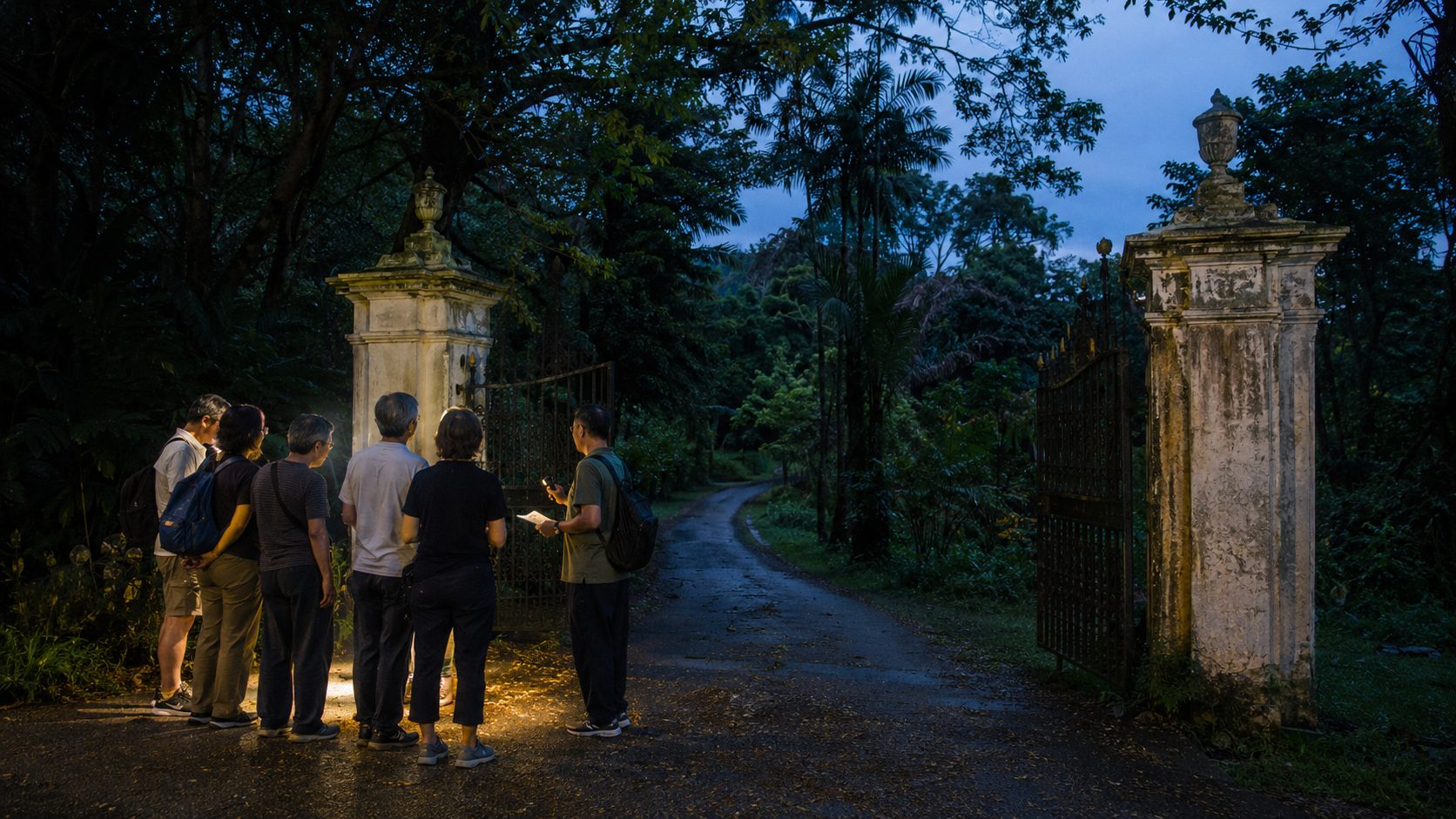
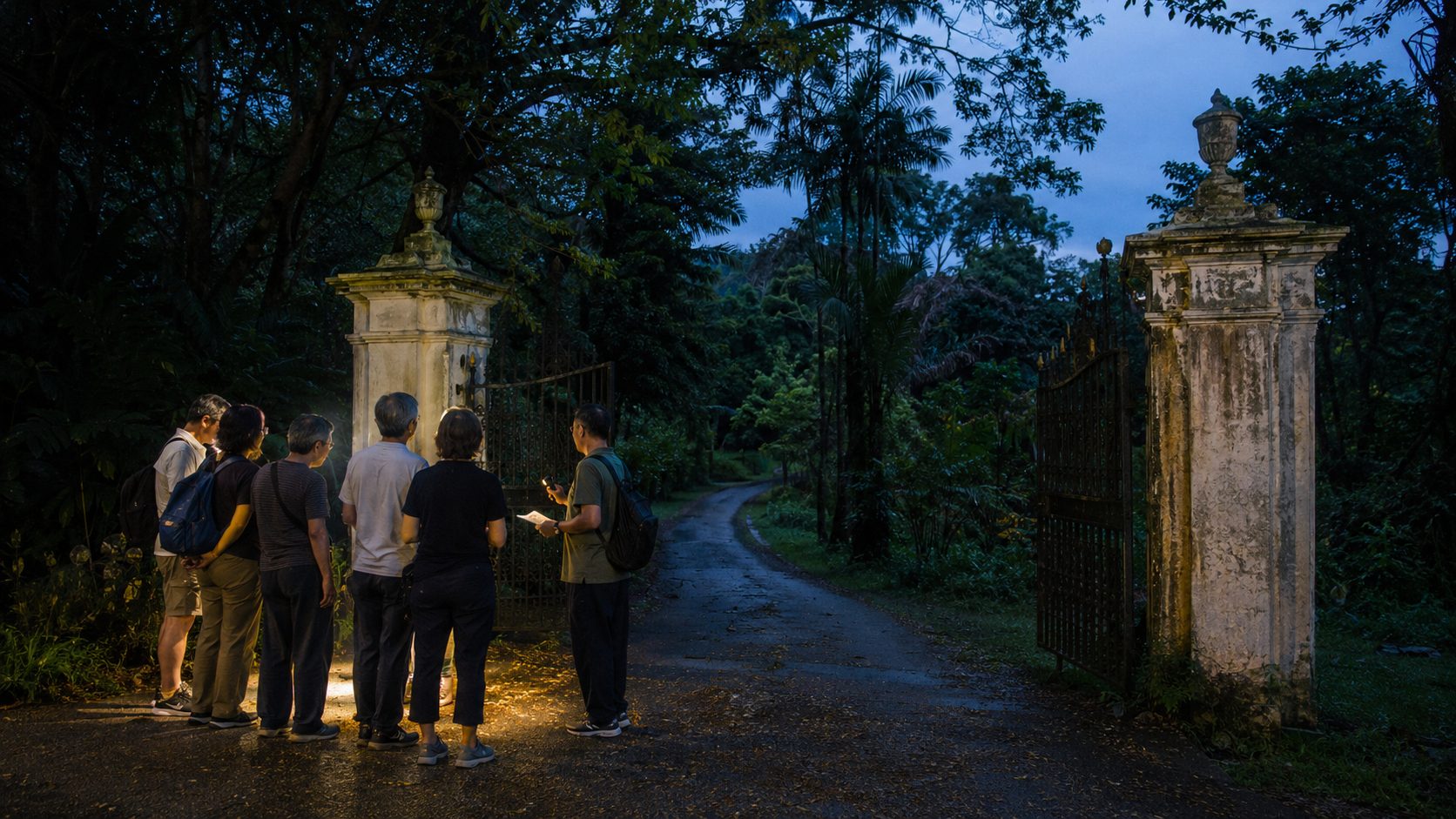
Image 1: A guide begins an evening walk at the threshold of the cemetery.
At nine at night, the cemetery becomes a classroom
At 9 p.m. on 17 August 2025, My Community Festival scheduled an unusual lesson. “After Hours @ My Bukit Brown”, hosted by guide Andrew Lin, was a two-hour walk through the “eternal” home of prominent Chinese Singaporeans. Its premise was not the supernatural, but a place for the dead that remains full of life. The details appear in the festival’s 2025 programme brochure.
That named host, hour and route format explain why Singapore still walks Bukit Brown. Descendants, researchers, guides, students and first-time visitors find history that is hard to meet elsewhere: street names on stones, motifs of protection and the afterlife, imported materials and paths where municipal planning meets a stubbornly hilly landscape.
At night, attention narrows. A torch finds one carved panel while everything beyond it recedes. Insects and leaves become louder; visitors watch each step. That slower pace creates the cemetery’s “strange intimacy”: public history being read at the edge of somebody else’s family space.
The right response is not fearlessness. It is care.
A public cemetery for a wider Chinese community
Part of the land had belonged to the Hokkien Ong clan and was known as Seh Ong Cemetery. The colonial municipality acquired a section between 1918 and 1919 as Singapore needed more public Chinese burial space.
The National Library Board’s history records its opening on 1 January 1922. Families initially objected to small standardised plots, but acceptance grew after layout improvements. By 1929, 40 per cent of registered Chinese burials within the municipality took place there.
The National Heritage Board’s online exhibition explains the social change. Unlike private family or clan cemeteries, Bukit Brown required no communal affiliation. Hokkien, Teochew, Cantonese, Hakka and Hainanese people of different surnames and means entered the same municipal landscape.
The cemetery closed to new burials in 1973 with about 100,000 tombs. It remains both a family landscape and a dense record of twentieth-century Chinese Singapore.
Darkness should reveal detail, not manufacture fear
Many first-timers arrive with stories of haunted roads or wandering spirits. These belong to popular culture but should not control a heritage visit. The cemetery’s inscriptions, materials, rituals and altered landscape are compelling enough.
A good guide uses darkness as a way of looking. Raking torchlight reveals shallow reliefs, tile edges, repaired cracks and old versus replacement stone without flooding the site or turning graves into a set.
Night also makes the group visible. People share light, warn of uneven ground and stop together. Nobody should wander for a photograph or hide behind a grave as a joke. Walking carefully becomes part of learning history.

Image 2: Raking light can reveal stone, tile, moss and repair without touching the monument.
How to read a tomb without reducing a life to decoration
Begin with the person: the deceased’s name, dates, relationships, occupation and the evidence for the account. Do not interpret a carved image from appearance alone. Meanings vary, restorations complicate the record and repetition can make speculation look factual.
Then look at structure: central marker, altar space and curved elements embracing the burial mound. Slope, orientation and neighbouring graves matter. At night, remain on a road or guide-approved approach; never enter a grave’s forecourt for a symmetrical photograph.
Materials tell another story. NHB identifies stone reliefs from China and ceramic tiles from Europe, placing funerary culture in an early twentieth-century global economy. Portraits, shields and mixed styles show Peranakan and Chinese families recombining visual languages. A tomb can be locally rooted and internationally connected.
Names connect the cemetery to Boon Lay, Chong Pang, Hong Lim and other familiar places. Yet a responsible walk is not a hall of fame: Bukit Brown’s municipal importance came from admitting people across status and communal divisions.
The Sikh guards and a cosmopolitan idea of protection
Stone Sikh guards stand beside some Chinese graves. The National Heritage Board’s record of an early-twentieth-century pair explains the association: Sikh men served as police and private watchmen, becoming identified with security in the Straits Settlements. Some Chinese families translated that living role into tomb guardians.
This is not an exotic curiosity but evidence of communities observing one another in a multicultural port. NHB’s Sikh Statue Trail says 30 pairs have been rediscovered across Bukit Brown and surrounding cemeteries, varying in size, features and uniforms.
At night, a torch should be aimed from the path and kept low. Do not touch the face, lean on the figure or stage a portrait between the pair. These are components of a grave, not freestanding public sculptures.

Image 3: Cross-cultural tomb guardians reflect Sikh associations with security in colonial Singapore.
The cemetery is still a family place
“Closed” means closed to new burials, not emptied of relationships. During Qing Ming, families locate ancestral graves, clear vegetation and make offerings. NHB also documents Seventh Month and Winter Clothing Festival rites. Kinship keeps this archive active.
Visitors should never assume that overgrowth means abandonment. Do not remove plants, food, cups, incense, paper, stones or markers. Do not sit on an altar ledge or place a bag on a tomb. If a family is praying, give them space and keep torches and cameras away.
Fire requires particular care. After Bukit Brown fires during Qing Ming in April 2026, NEA advised against unattended burning, burning on the ground, scattered paper and abandoned offerings. Visitors should never light incense, candles or joss paper for atmosphere. Rituals are not props, and dry vegetation can carry fire.
A first-timer’s night route
This is a guided-route framework, not a self-guided set of grave coordinates. Conditions change, and any published walk must be reconfirmed with the organiser and relevant authority.
Stop 1: The organiser��s confirmed meeting point
Meet outside the cemetery at the exact location and time supplied by the guide. Do not assume an online pin marks a safe entrance. The restored cast-iron gates offer a useful opening story: originally located at old Lorong Halwa, the four gates and columns were removed, refurbished and reinstalled at a new access road in 2016. NHB documents the process in its history of the Bukit Brown Cemetery gates.
Stop 2: The municipal road and hillside
Walk as a compact group on a known road. Notice how graves occupy slopes rather than a flat grid. Listen to the guide explain how a municipal system met geomantic preferences and family choices. Keep torch beams below eye level and use them mainly for footing.
Stop 3: One grave, read slowly
A guide should select an accessible tomb and establish the person before discussing design. Read a date, relationship or verified name; then examine material and form. One well-supported life is more memorable than ten rapidly recited “famous pioneers”.
Stop 4: A guardian or decorative motif
Where the route safely permits, compare a guardian, relief, tile or portrait treatment. Discuss what is known, what remains uncertain and whether the object has been repaired or relocated. Do not cross vegetation to reach a feature.
Stop 5: Return by the agreed road
End at the stated meeting point and account for every participant. A night walk should not conclude with visitors finding separate exits in the dark. The guide should allow time for transport arrangements and provide a wet-weather or emergency plan.

Image 4: At night, group discipline is part of heritage care.
Practical visit information
Location reference: Bukit Brown Cemetery is commonly mapped at 36C Lorong Halwa, Singapore 298637. Use the organiser’s live instructions rather than relying on an old article or map pin.
Night access: Join only a currently advertised, organised walk whose host has confirmed access, route, meeting point and end time. The 2025 Andrew Lin event is historical evidence of night programming, not a current booking.
Duration: Allow about two hours for a guided night walk, plus travel and a buffer at the finish.
Bring: Covered shoes with grip, long trousers, water, insect repellent, a charged phone, a small torch and light rain protection. Avoid umbrellas in a close group if they obstruct vision; follow the organiser’s weather policy.
Do not bring or use: Candles, joss sticks, fireworks, alcohol, loud speakers, drones or props for staged supernatural photographs.
Accessibility: Expect slopes, darkness, uneven surfaces and possible roots or leaf litter. Ask the organiser about the exact route before booking; do not assume it is step-free or wheelchair accessible.
Weather: Do not enter during lightning, intense rain, haze or any closure. Follow the organiser if a walk is delayed or cancelled.
Photography: Disable flash unless the guide specifically permits it. Do not photograph worshippers, descendants or identifiable participants without consent. Commercial photography may require separate permission.
Field notes and community consent
The production version should record the night precisely: arrival time, weather, light level, route condition, sounds at each stop and the evidence used for every grave identification. Separate observation from interpretation. “The stone was wet” is an observation; “the family chose this motif because…” requires a source.
For contributions, record the person’s preferred name, relationship to Bukit Brown, approved quotation, intended channels and permission date. Descendant testimony requires particular care because a family story may include living relatives. Consent to an interview does not automatically cover a portrait, social-media clip, tour script or commercial gift.
Send the relevant section back to the contributor for factual review. Credit research and guiding labour. If SingaporeHeritage.sg earns from a walk or product based substantially on a community member’s knowledge, agree in advance how that person or community benefits.
Key takeaways
- Bukit Brown matters as a municipal, family, ritual and civic landscape.
- Night walking works best when darkness slows attention instead of manufacturing fear.
- Read the deceased person before treating the tomb as a collection of motifs.
- Sikh guard figures reveal a multicultural history of security and protection.
- “Closed cemetery” does not mean culturally abandoned.
- Guided access, group discipline, fire safety and consent are essential after dark.
Frequently asked questions
1. Is Bukit Brown Cemetery open to visitors at night?
Do not treat a map listing or old event as permission for unrestricted night access. Join only a currently confirmed organised walk whose host has checked the route and meeting point. The 2025 festival tour does not establish permanent hours. If no night programme is available, visit with a guide in daylight.
2. Is it safe to walk Bukit Brown after dark?
An organised group reduces risk but cannot remove it. Expect slopes, roots, wet leaves, insects and low visibility. Wear covered shoes, carry water and a torch, keep your phone charged and stay with the guide. Do not explore alone or continue during lightning, heavy rain, haze or fire.
3. Is Bukit Brown haunted?
Ghost stories circulate around many cemeteries, but this article does not verify paranormal claims. Bukit Brown’s documented families, inscriptions, rituals and civic history are compelling without them. Respect different spiritual beliefs; do not mock them, stage apparitions, hide among graves or frighten other visitors.
4. When did Bukit Brown Cemetery open and close?
It officially opened on 1 January 1922 and closed to new burials in 1973. The municipality had acquired part of the former Seh Ong Cemetery land between 1918 and 1919. By 1929, Bukit Brown handled 40 per cent of registered Chinese burials within municipal limits; it held about 100,000 tombs at closure.
5. Who is buried at Bukit Brown?
People of different Chinese dialect groups, surnames and social positions are buried there. They include entrepreneurs, philanthropists, writers and community leaders, but the site should not become a hall of famous men. Its deeper importance is the wider municipal population—including commoners and women whose histories are less visible.
6. What can I see more clearly at night?
A low torch beam can emphasise reliefs, cracks, tile edges, moss and curved stone. Darkness also slows the group and changes the soundscape. It is not always better: colour, inscriptions and landscape context may be clearer by day, while interpretation still depends on research and descendant knowledge.
7. What should I wear and bring?
Wear covered shoes with grip, long trousers and light clothing. Bring water, insect repellent, a charged phone, a small torch and compact rain protection. Avoid sandals, heels and bulky equipment that affects balance. Follow the organiser’s weather instructions and take all rubbish away.
8. Can I photograph graves and tour participants?
Follow the guide’s rules. Avoid flash, active rituals and angles that require stepping into grave plots. Obtain permission before photographing identifiable guides, participants, descendants or worshippers. Tour attendance is not consent for social media or advertising. Commercial filming, drones and staged shoots may need separate approval.
9. May I touch a tomb, clear plants or move an offering?
No, unless a descendant or authorised conservation team directs it. Moving plants, cups, paper, stones, markers or food destroys context and may cause offence. Never lean on statues, sit on altar ledges, trace inscriptions or wet a stone for a photograph. Let trained people handle conservation.
10. What happens at Bukit Brown during Qing Ming?
Families locate and tend ancestral graves, pay respects and make offerings. This is living heritage, not a performance for visitors. Give families priority and never photograph rites without permission. Do not leave burning material unattended, burn on the ground or let paper scatter; tours should not interfere with observance.
11. Are night walks suitable for children or people with limited mobility?
It depends on the exact route, light and weather. Ask before booking about distance, slopes, steps, rest points, toilets, emergency exits and accessible alternatives. Darkness and uneven ground may be unsuitable for some visitors. A daylight talk or shorter programme can be the better experience.
12. How long does a Bukit Brown night tour take?
The documented 2025 festival tour ran from 9 p.m. to 11 p.m., making two hours a useful reference rather than a rule. Add time for briefing, transport and departure. Confirm the actual finish before arranging your journey home; routes vary with access, weather and the guide’s stories.
13. Can I visit Bukit Brown in daylight instead?
Yes. Daylight is better for many first-timers because terrain, inscriptions and route choices are easier to assess. A reputable guide can add historical context without damaging the landscape. Bring covered shoes, water and weather protection, and follow the same rules on access, offerings and photography.
Related reading and next steps
- Explore the developing Bukit Brown neighbourhood collection.
- Read more Singapore place stories.
- Contribute a family account through Submit a Memory.
- Carry a researched route home with the Memory Map Print.
Walk with a guide
Do not make your first Bukit Brown night visit alone. Check SingaporeHeritage.sg’s guided heritage walks and join a route built around evidence, safety and respect.
Source credits
- National Library Board, “Bukit Brown Municipal Cemetery,” Singapore Infopedia.
- National Heritage Board, Bukit Brown Cemetery online exhibition.
- My Community Festival, 2025 Programme Brochure, “After Hours @ My Bukit Brown with Andrew Lin,” p. 43.
- National Heritage Board, Refurbishment of Bukit Brown Cemetery Gates.
- National Heritage Board, A Pair of Sikh Guard Figures and Sikh Statue Trail.
- The Straits Times, NEA urges responsible burning after fires at Bukit Brown Cemetery, 2 April 2026.