Key Takeaways
Queenstown remains one of Singapore’s clearest examples of how housing, planning and community life grew together.
- Queenstown was Singapore’s first satellite town, developed in response to a serious post-war housing shortage.
- Its early estates combined flats with schools, healthcare, shops, transport and open spaces.
- Markets, hawker centres, cinemas and community institutions gave the new town a daily rhythm.
- Redevelopment has changed the landscape, while older blocks and memories continue to anchor its identity.
- A walk through Queenstown reveals Singapore’s wider story through ordinary homes, streets and routines.
Queenstown before the satellite town
Before the towers and broad roads, Queenstown was a rural corner of Singapore shaped by villages, farms, streams and smallholdings. The district’s later identity was built over an older landscape rather than on an empty site. To understand Queenstown Singapore history, it helps to begin with the people and places that came before public housing.
The villages and rural settlements that came first
The area included kampongs and rural settlements such as Boh Beh Kang, a name commonly associated with the local landscape and its waterways. Families lived in modest houses, tended plots of land and relied on close neighbourhood ties. The daily scene was quieter and more dispersed than the planned estate that would follow, with paths and streams shaping movement through the area.
This kind of ordinary settlement belongs to the wider story of Singapore’s everyday history, where infrastructure and migration altered routines long before the modern skyline appeared. Queenstown’s transformation was therefore not simply architectural; it also involved the relocation and reorganisation of established communities.
Singapore’s post-war housing crisis
After the Second World War, Singapore faced overcrowding, poor housing conditions and a rapidly growing population. Many families lived in cramped rooms or informal settlements, while demand for safe, affordable homes far exceeded supply. Housing became a practical necessity and a central concern of public policy.
The pressure was visible in the contrast between the city centre’s dense quarters and the looser rural edges. A new approach was needed: housing had to be produced at scale, but it also had to support schools, transport, health services and the routines of family life.
Why the area was chosen for large-scale development
Queenstown offered space close enough to the central city to remain connected, yet open enough for comprehensive planning. Its position near established roads made it suitable for new routes and public transport, while the available land allowed planners to arrange housing in groups rather than as isolated buildings.
The choice also reflected the practical geography of post-war Singapore. A satellite town could take pressure off the centre while giving residents access to a more complete neighbourhood. That balance between distance and connection would become one of Queenstown’s defining qualities.
The meaning behind the name Queenstown
Queenstown was named in 1953 to mark the coronation of Queen Elizabeth II. The name gave the new development an official identity as it began to emerge from its rural setting. It also fixed the estate within the political language of the period, when Singapore was still a British colony.
Over time, however, residents made the name their own. Queenstown ceased to be merely an administrative label and became shorthand for particular blocks, schools, food stalls, playing fields and friendships. Place names gain their deepest meaning through repeated use in everyday life.
The birth of Singapore’s first satellite town
Queenstown was conceived as more than a collection of flats. It was an experiment in building a new kind of urban community beyond the crowded centre, with homes and services planned together. The first phases set patterns that would influence public housing across Singapore for decades.
The Singapore Improvement Trust’s early housing plans
The Singapore Improvement Trust, or SIT, began developing housing in Queenstown before the Housing and Development Board was established. Its work formed part of an earlier public response to overcrowding, introducing planned blocks and more reliable services to families who had often lived in difficult conditions.
The early estates were not identical to the later HDB town, but they helped establish the area as a testing ground for public housing. Their layouts, construction methods and relationship to roads offered lessons that could be applied on a much larger scale.
The transition from SIT to the Housing and Development Board
In 1960, the Housing and Development Board replaced the SIT and took on a far broader building programme. The change came at a moment when speed and volume mattered: Singapore needed many more homes, and the new board had the mandate to deliver them.
Queenstown became one of the places where that ambition could be seen clearly. The town’s growing estates reflected a shift from limited improvement schemes to coordinated national housing, with standardised construction supporting rapid delivery.
How Queenstown was designed as a self-contained community
A self-contained town was intended to reduce the need for residents to travel across the island for basic services. Housing was arranged alongside schools, clinics, shops, places of worship, recreation grounds and community facilities. The result was a neighbourhood where a child’s school, a parent’s market and an elderly resident’s clinic might all sit within familiar walking distance.
That planning principle also gave Queenstown a social centre of gravity. Corridors, void decks, playgrounds and shopfronts became informal meeting places, allowing private family life to overlap with shared neighbourhood routines.
The first estates around Stirling Road and Commonwealth Avenue
Stirling Road and Commonwealth Avenue became important early axes of development. Blocks rose beside newly improved roads, and estates such as Princess Margaret Estate helped establish Queenstown’s reputation as a pioneer town. The buildings were practical, but their spacing and access to light and air also shaped how residents experienced home.
The town’s first generation of estates can still be read as a record of changing confidence. Early buildings answered an urgent housing need; later additions expressed a more settled idea of what a complete public town might contain.
Planning a new way of urban living
Queenstown changed the physical scale of domestic life. Families who had known kampong houses, rented rooms or crowded shophouses moved into flats with formal services, numbered addresses and shared facilities. The town’s plan brought together the practical systems that make a neighbourhood work.
High-rise flats and modern family homes
For many residents, the flat represented security and modernity: a permanent home with water, electricity and a clearer sense of privacy. Different block types and flat sizes accommodated households at various stages of life, while taller buildings made efficient use of limited land.
The architecture was never only about height. Verandas, windows, breezeways and generous spaces between blocks helped adapt the buildings to Singapore’s tropical climate. As Queenstown’s pioneering architecture shows, these details are part of the estate’s social history as much as its visual character.
Schools, clinics and shops within walking distance
The neighbourhood plan worked because daily needs were not treated as afterthoughts. Schools served children close to home, clinics provided accessible care, and small shops supplied groceries and household necessities. These facilities turned a residential development into a lived town.
The pattern can be summarised simply:
- Schools gave children a familiar daily route.
- Clinics brought basic healthcare closer to families.
- Shops and markets supported ordinary household routines.
- Community facilities created places for meeting and organising.
These destinations also produced repeated encounters. A walk to buy bread, collect medicine or attend class could become part of the social fabric, linking households that might otherwise have remained strangers.
Roads, public transport and connections to central Singapore
Queenstown’s location made connectivity central to its success. Commonwealth Avenue, Queensway and surrounding roads tied the estate to the city and to other developing districts. Public transport allowed residents to reach work, school and commerce beyond the town, even as local facilities reduced the need for constant travel.
Later rail connections strengthened that relationship with the wider island. Yet the original planning idea remained visible: a satellite town should be connected to the centre without depending entirely on it.
The role of open spaces and shared amenities
Open space gave the new density room to breathe. Playing fields, small parks, courtyards and landscaped edges offered children somewhere to run and adults somewhere to pause. Shared amenities softened the boundary between the flat and the wider estate.
They also carried an important social function. Residents encountered one another in spaces that were neither fully private nor formally commercial, and those encounters helped turn a planned settlement into a community with its own habits and memories.
Everyday life in early Queenstown
The history of a satellite town is best understood through its routines. Moving day, the morning market, a school bell, a bus ride and an evening beneath the block all reveal how planning became personal. Queenstown’s residents gave the estate its character through the ways they used and remembered it.
Moving from kampongs into new flats
Moving into a flat could feel liberating and unsettling at once. Families gained better services and more secure housing, but they also had to adjust to shared staircases, lifts, corridors and neighbours living close by. Sounds travelled, children made friends quickly, and domestic life became more visibly part of a larger building.
The transition changed household habits too. Cooking, washing and entertaining moved into a more compact setting, while the estate outside the front door became an extension of family life. For older residents, the move often carried memories of what had been left behind as well as hopes for the future.
Markets, hawker centres and neighbourhood commerce
Food shops, markets and hawker centres supplied more than meals. They were places where residents exchanged news, recognised familiar faces and measured the pace of the morning. The sounds of chopping, frying and conversation made commerce feel close to home.
Singapore’s wider hawker culture and shared dining spaces help explain why such places matter beyond their menus. In Queenstown, foodways connected generations: a dish could preserve a family preference, a stall could become a landmark, and a regular breakfast could anchor a week.
Schools, clubs and community institutions
Schools and clubs gave the young town its organised life. They offered education, sport, performance and opportunities for residents to meet beyond the immediate household. Community institutions also helped newcomers form relationships in an estate where many families were learning how to live alongside one another.
Libraries, associations and activity groups created a sense of belonging that housing alone could not provide. Their importance was often quiet and cumulative, built through lessons attended, games played and conversations repeated over many years.
The experiences of Queenstown’s first generations of residents
The first generations experienced Queenstown as both a national project and a personal home. They saw empty land become streets, watched neighbours arrive from different parts of Singapore and raised children in a town that was still acquiring its landmarks. Their memories are varied: pride in a first proper home, affection for a favourite stall, frustration with growing crowds, and sadness when familiar blocks disappeared.
That range of feeling matters. A neighbourhood’s heritage is not a single official story but a collection of lived accounts, much like the stories of ordinary Singaporeans preserved through family memories and community history.
Landmarks that tell Queenstown’s story
Queenstown’s landmarks are not all grand monuments. Some are working places, some have vanished, and others survive as recognisable blocks or names on a map. Together they show how healthcare, entertainment, food, reading and housing became part of the town’s identity.
Queenstown Polyclinic and the growth of public healthcare
Queenstown Polyclinic represents the way public healthcare became embedded in the new estate. A nearby clinic meant that families could seek care without crossing the island, making health services part of the ordinary geography of home, school and work.
Its significance lies in that everyday accessibility. Public healthcare was experienced not as an abstract national achievement but as a waiting room, a familiar route and a service relied on by several generations.
The former Queenstown Cinema and neighbourhood entertainment
The former Queenstown Cinema recalls a time when entertainment was woven into the neighbourhood rather than concentrated in large commercial complexes. A cinema offered an evening destination for families, young people and couples, and its presence gave the estate another shared reference point.
Even after such venues close, their names remain in conversation. Residents remember queues, films, meeting places and the particular excitement of going out locally for the night.
Tanglin Halt Food Centre and the culture of local food
Tanglin Halt Food Centre became closely associated with the food culture of the estate. Its stalls and surrounding activity show how hawker centres function as practical kitchens, social rooms and repositories of taste. Residents return not only for a meal but for a familiar rhythm and a connection to earlier years.
The objects of food culture matter as well: enamel cups, tiled tables, order calls and handwritten notes can hold as much memory as a building. That is why kopitiam objects and memories offer such a useful way to read Singapore’s everyday heritage.
Libraries, community centres and public gathering places
Libraries and community centres extended the town’s public life beyond shopping and housing. They offered rooms for classes, reading, meetings and performances, creating a civic layer within the estate. These places helped residents develop interests and relationships that crossed age and block.
A gathering place does not need to be monumental to be significant. Its value grows through repeated use, especially when it gives children, families and older residents reasons to share the same local space.
Housing blocks as examples of Singapore’s architectural history
Queenstown’s blocks document the changing language of public housing. Their forms reflect different periods of construction, from early low-rise and slab blocks to taller buildings with distinctive proportions and circulation spaces. Some became instantly recognisable through colour, shape or the way they met the surrounding landscape.
For visitors, the buildings reward slow observation. A staircase, façade, void deck or sheltered walkway can reveal how architects and residents negotiated climate, privacy and community in a dense city.
Queenstown’s transformation over the decades
No estate remains fixed. Queenstown has absorbed new homes, transport links, services and generations of residents while losing parts of its earlier fabric. The challenge has been to renew a working town without erasing the evidence of how it began.
Redevelopment and the changing shape of the estate
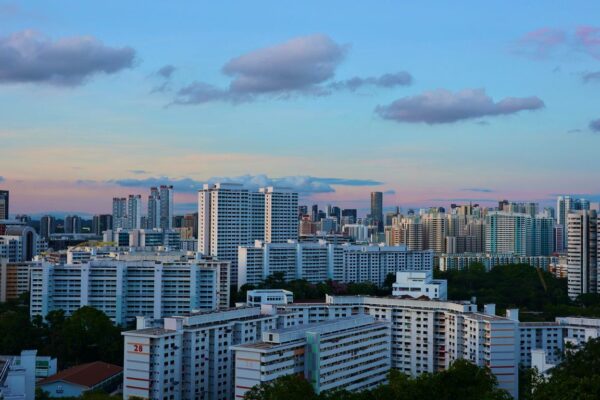
Redevelopment has brought newer flats, refreshed public spaces and different patterns of density. Areas that once consisted of compact blocks and open fields now include contemporary housing and carefully designed pedestrian routes. The change reflects both ageing buildings and shifting expectations of urban life.
For residents, redevelopment is never merely a planning exercise. It can mean better lifts, larger facilities and improved accessibility, but it can also alter views, walking routes and the familiar scale of the neighbourhood.
The Selective En bloc Redevelopment Scheme and its impact
The Selective En bloc Redevelopment Scheme, introduced in the 1990s, allowed selected older blocks to be replaced while residents were offered new homes nearby. In Queenstown, the scheme accelerated renewal and changed the appearance of several parts of the estate.
Its impact was practical and emotional. Relocation could bring improved housing, yet the demolition of a block also removed a physical setting where family histories, neighbourly habits and childhood memories had accumulated.
New housing at Dawson, Alexandra and Margaret Drive
Newer developments around Dawson, Alexandra and Margaret Drive show how Queenstown continues to be planned for contemporary needs. Higher-density housing, landscaped routes and updated amenities have extended the town’s residential role while linking it to workplaces, parks and transport.
These areas sit beside older estates rather than existing in isolation. Their relationship creates a layered townscape in which different ideas of public housing can be read within a short walk.
The loss and preservation of older buildings
Some older buildings have disappeared, while others have gained recognition for their architectural or social value. Preservation is not always about freezing a neighbourhood; it can also involve recording stories, retaining distinctive structures and allowing new uses to emerge.
The most thoughtful approach keeps residents in view. A conserved façade means more when its history is connected to the people who lived, worked and gathered there, rather than treated as a decorative object detached from its community.
Queenstown’s heritage and enduring legacy
Queenstown’s importance reaches beyond the claim of being first. It demonstrates how a housing estate can become a social landscape, where policy is translated into kitchens, corridors, playgrounds and shared meals. Its story also shows that urban heritage is constantly negotiated between renewal and remembrance.
What makes Queenstown significant in Singapore’s history
Queenstown was an early test of the idea that public housing could form a complete town. Its development brought together large-scale construction, local services, transport and community facilities at a time when Singapore was confronting urgent housing needs.
The estate therefore sits at the meeting point of national history and private memory. The broad story belongs to Singapore, but its meaning is carried by residents who remember particular blocks, routes, shops and neighbours.
Heritage trails and places visitors can still explore
Visitors can explore Queenstown through its remaining estates, food centres, roads, public buildings and changing skyline. A heritage walk works best when it follows the relationship between places rather than treating each landmark as an isolated stop. The Queenstown pioneer town trail offers one route into that layered history.
Singapore Heritage’s small-group heritage walks take a similar story-led approach, connecting streets and buildings with the people and practices that made them meaningful. The experience is less about collecting sights than noticing how a town is lived.
Stories of residents, memories and community identity
Resident stories give Queenstown its warmth. They include accounts of moving into a first flat, learning a route by bus, buying breakfast at Tanglin Halt or meeting friends beneath a block. Some memories are joyful, others complicated, especially when relocation or redevelopment changed a familiar setting.
Singapore Heritage also creates story-led heritage experiences and researched gifts rooted in neighbourhoods, foodways and everyday practices. That approach respects the fact that heritage is carried by people, makers and communities, not only by official plaques.
How the first satellite town continues to evolve
Queenstown continues to change as new residents arrive and older generations pass on their recollections. New housing and public spaces sit alongside older blocks, while food stalls, schools and familiar routes keep renewing the estate’s social life. The town’s identity is therefore cumulative rather than preserved in one untouched form.
Its lasting lesson is simple: successful urban history is found in the connection between design and daily use. Queenstown remains worth exploring because its streets show how a national housing project became a lived neighbourhood.
Conclusion
Queenstown’s story is the story of Singapore learning to build not only homes, but communities. Its blocks, markets, clinics, schools and memories reveal how ordinary life gave meaning to an ambitious plan, and why the first satellite town still matters today.
Frequently Asked Questions
Why is Queenstown called Singapore’s first satellite town?
Queenstown is regarded as Singapore’s first satellite town because it was planned as a substantial residential community outside the central city, with housing and essential services developed together.
When did Queenstown begin to develop?
Major development began in the 1950s, with early work associated with the Singapore Improvement Trust followed by the much larger public housing programme of the Housing and Development Board.
What was Queenstown like before public housing?
Before the estates were built, the area contained rural settlements, kampongs, farms and smallholdings, including communities associated with Boh Beh Kang.
Which places are associated with Queenstown’s heritage?
Important places include early housing estates, Tanglin Halt Food Centre, Queenstown Polyclinic, former entertainment venues, community facilities and distinctive older housing blocks.
How did redevelopment affect Queenstown?
Redevelopment introduced newer homes and facilities, but it also led to the demolition or relocation of some older blocks, changing familiar landscapes and community routines.
Can visitors explore Queenstown on foot?
Yes. Visitors can walk between older estates, food centres, public buildings, open spaces and newer developments, although routes and access arrangements should be checked before setting out.
Why is Queenstown important to Singapore’s wider history?
Queenstown shows how Singapore used public housing and town planning to respond to post-war overcrowding while creating neighbourhoods where services, transport and community life could develop together.
Explore Queenstown With Stories
Readers can discover more through a small-group Singapore Heritage walk, where local streets, foodways and resident memories provide a slower, more human way into Queenstown’s past. Those who prefer to begin independently can plan a heritage walk and continue exploring at their own pace.