Key Takeaways
Kampong Glam is best understood as a living neighbourhood, shaped by royal power, maritime trade, faith and ordinary routines.
- The name Kampong Glam is associated with the gelam tree and an older coastal settlement.
- Malay, Bugis and Orang Laut communities connected the area to regional sea routes.
- Sultan Hussein Shah’s settlement with the British helped establish Kampong Glam as a Malay royal seat.
- Arab Street grew through merchant, textile, food and pilgrimage networks.
- The district’s conserved buildings and active businesses keep its history visible, though not unchanged.
Kampong Glam before the colonial era
Long before the British trading post, the area around present-day Kampong Glam was a coastal place of movement. Boats, river mouths, mangrove edges and small settlements linked it to the wider Malay world. Its history therefore begins less with grand buildings than with water, work and people who knew how to read the tides.
The story is layered, and some details remain matters of interpretation. Even so, the district’s older identity is clear: Kampong Glam was connected to maritime life before it became associated with royal residences, mosques and shophouses. This Kampong Glam history offers a useful reminder that the neighbourhood’s past did not begin in 1819.
The meaning and origins of the name Kampong Glam
“Kampong” means village, while “gelam” is the Malay name associated with a melaleuca tree found in the region. The name is commonly understood as “gelam village”, tying the settlement to its natural surroundings as well as to its residents. Gelam had practical uses, including timber, bark and leaves, so the name evokes a working landscape rather than a decorative label.
Names, however, rarely preserve a single complete story. Kampong Glam also refers to the people, occupations and routes that gathered around the place. The word carries a sense of settlement: a village shaped by use, exchange and belonging.
The coastal landscape around the Rochor River
The Rochor River and nearby shoreline gave the settlement access to boats and goods moving along Singapore’s north-eastern coast. Before extensive reclamation and modern roads, the edge between land and water was less fixed. Small craft could carry people, food and materials between settlements, while larger regional networks brought traders closer to the island.
That watery geography helps explain why Kampong Glam developed as a place of arrival. Its later streets may feel firmly urban, but the older landscape was open, tidal and practical. River access made the district part of a much wider pattern of movement.
Malay, Bugis and Orang Laut connections
Malay communities, Bugis seafarers and Orang Laut groups all formed part of the region’s overlapping maritime world. Their roles were varied: some sailed, some traded, some worked as boatmen, and others supported the movement of goods between shore and ship. It would be misleading to imagine these communities as isolated categories; family, language, work and allegiance often crossed neat boundaries.
The Orang Laut, or “sea people”, are especially important to the early story because their knowledge was grounded in water. Their presence points to a settlement that depended on skilled coastal labour. It also places Kampong Glam within the history of Singapore’s ordinary seafarers, not only its later institutions.
Trade routes linking the settlement to the wider region
Kampong Glam’s early connections reached across the Malay Archipelago, linking Singapore with ports in the Riau Islands, the Malay Peninsula, Sumatra and beyond. These routes carried people and perishable goods as well as textiles, spices and news. Trade was social as much as economic, relying on kinship, trust and repeated journeys.
That regional outlook survived into the nineteenth century. The settlement’s importance came from its position within a network, and its later Arab Street businesses continued that habit of looking outward. The district was never simply a local village cut off from the sea.
Royalty and the making of a Malay seat
The nineteenth century brought a decisive political change. British plans for a trading post intersected with a succession dispute within the Johor Sultanate, giving Kampong Glam a new role as a royal and administrative centre. The settlement was not created from nothing, but its land use and symbolic importance were reshaped.
Royal authority brought households, followers, religious institutions and commercial activity into closer relationship. The resulting district held several kinds of power at once: dynastic, spiritual, social and economic.
Sultan Hussein Shah and the 1819 political settlement
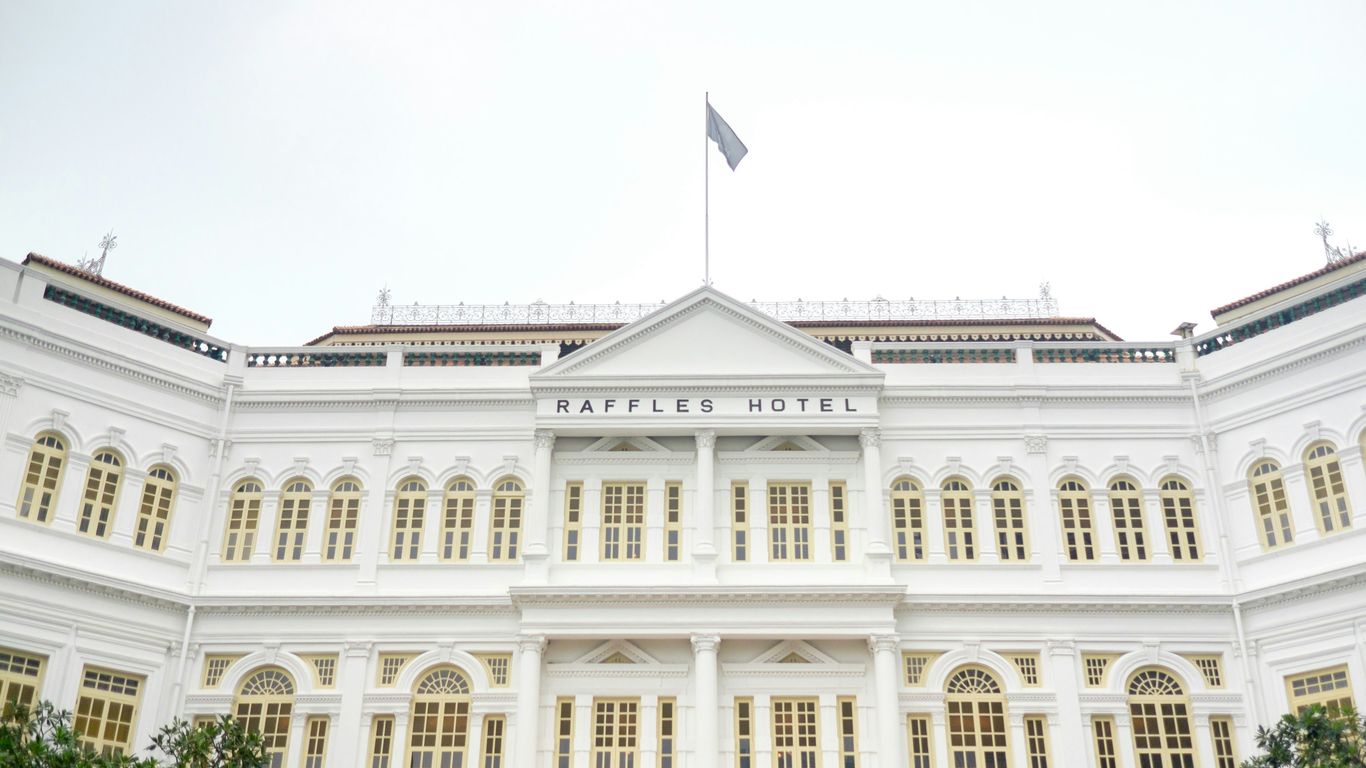
In 1819, Sultan Hussein Shah of Johor and Temenggong Abdul Rahman entered an agreement with the British East India Company, allowing the company to establish a trading post in Singapore. The agreement emerged from a contested succession and a calculated political settlement. For Sultan Hussein, the arrangement also provided recognition and a place for his household and followers.
The settlement altered Singapore’s future, but it should not be read only as a British beginning. Malay political authority and existing regional connections were central to the negotiations. Kampong Glam became one visible expression of that entangled history.
The land grant that shaped Kampong Glam
Land granted to Sultan Hussein and his family gave Kampong Glam a defined royal centre. It also supported the arrival and settlement of Malay, Arab and other Muslim communities in the surrounding area. The grant shaped where residences, religious buildings and commercial streets would develop.
A land grant can sound abstract on paper. On the ground, it affected who could live nearby, where visitors gathered and how authority was displayed. The district’s later character grew from these practical consequences as much as from the agreement itself.
The Istana Kampong Glam as a royal residence
The Istana Kampong Glam became the royal residence associated with Sultan Hussein’s family. Its presence gave the neighbourhood a courtly focus, while the surrounding streets remained active with trade, worship and domestic life. The residence was therefore part of a wider urban setting, not a detached palace landscape.
Today, the istana helps visitors see how royal history occupied ordinary space. Its value lies not only in its architecture, but in the questions it raises about household life, inheritance and the changing place of Malay royalty in colonial Singapore.
Royal authority, community life and changing influence
Royal influence did not remain fixed. As British administration expanded and commercial power shifted, the sultan’s practical authority changed, even while the symbolic importance of the royal household endured. Community life around the istana continued through families, merchants, religious teachers and workers whose daily activity gave the district its texture.
This balance between formal authority and lived experience is central to Kampong Glam. The neighbourhood’s history cannot be reduced to a royal story, but neither can royalty be treated as a picturesque footnote. Both shaped the streets together.
Traders, pilgrims and the commercial life of Arab Street
Arab Street grew from the movement of merchants, goods and travellers through Kampong Glam. Its name reflects one strand of that history, but the commercial life of the area was never limited to a single community. Bugis, Arab, Indian Muslim and Malay networks overlapped in shops, warehouses, homes and places of worship.
The district’s shops served both local residents and regional visitors. A roll of cloth, a spice, a cup of coffee or a travel arrangement could connect a small street to a much larger world.

Why Arab Street became a centre for regional trade
Arab Street occupied a useful position near the royal settlement, the harbour and routes leading into the growing town. Merchants could meet customers, store goods and arrange onward journeys within a compact area. As Singapore’s port expanded, the neighbourhood benefited from the circulation of people who already had commercial and family connections across the region.
Its reputation was built through repetition. Traders returned because relationships mattered, and customers returned because particular shops carried trusted goods. The street’s commercial identity was therefore made over time, through many modest transactions.
Bugis, Arab, Indian Muslim and Malay merchant networks
Merchant communities brought different languages, religious traditions and business practices into close contact. Bugis traders connected the area to island networks, while Arab and Indian Muslim merchants helped sustain trade across the Indian Ocean and the Malay world. Malay families, shopkeepers and workers were equally central to the neighbourhood’s daily operation.
The result was not a simple mosaic of separate enclaves. It was a shared commercial environment in which people borrowed styles, exchanged information and built relationships across community lines. That layered quality remains one of the most compelling parts of the district.
Textiles, spices and other goods sold in the neighbourhood
Textiles became one of Arab Street’s most recognisable trades, alongside spices, perfumes, foodstuffs and goods associated with religious and family occasions. Cloth shops served people choosing materials for everyday clothing as well as weddings and festivals. The goods were practical, but they also carried colour, status and memory.
A visitor might find it useful to think of the shops by the needs they answered:
- Fabric for clothing, ceremony and household use.
- Spices and ingredients moving between kitchen and market.
- Travel-related goods for regional visitors and pilgrims.
- Food and drink that made trading streets places to linger.
These categories overlap, as they did in the past. The commercial life of Arab Street was never only about buying objects; it was also about advice, familiarity and the social rhythm around a shopfront.
The importance of pilgrimage connections to Mecca and Medina
For Muslim travellers from the region, Singapore could be part of a longer journey towards Mecca and Medina. Merchants and agents helped arrange passages, supplies and information, while neighbourhood institutions offered social and religious support. Pilgrimage connections strengthened the district’s links beyond Southeast Asia.
Those journeys also brought stories home. News from distant ports, changes in prices and encounters with other Muslim communities entered local conversation. In this way, Arab Street’s commercial history was closely tied to faith and travel rather than separate from them.
Sultan Mosque and the district’s religious identity
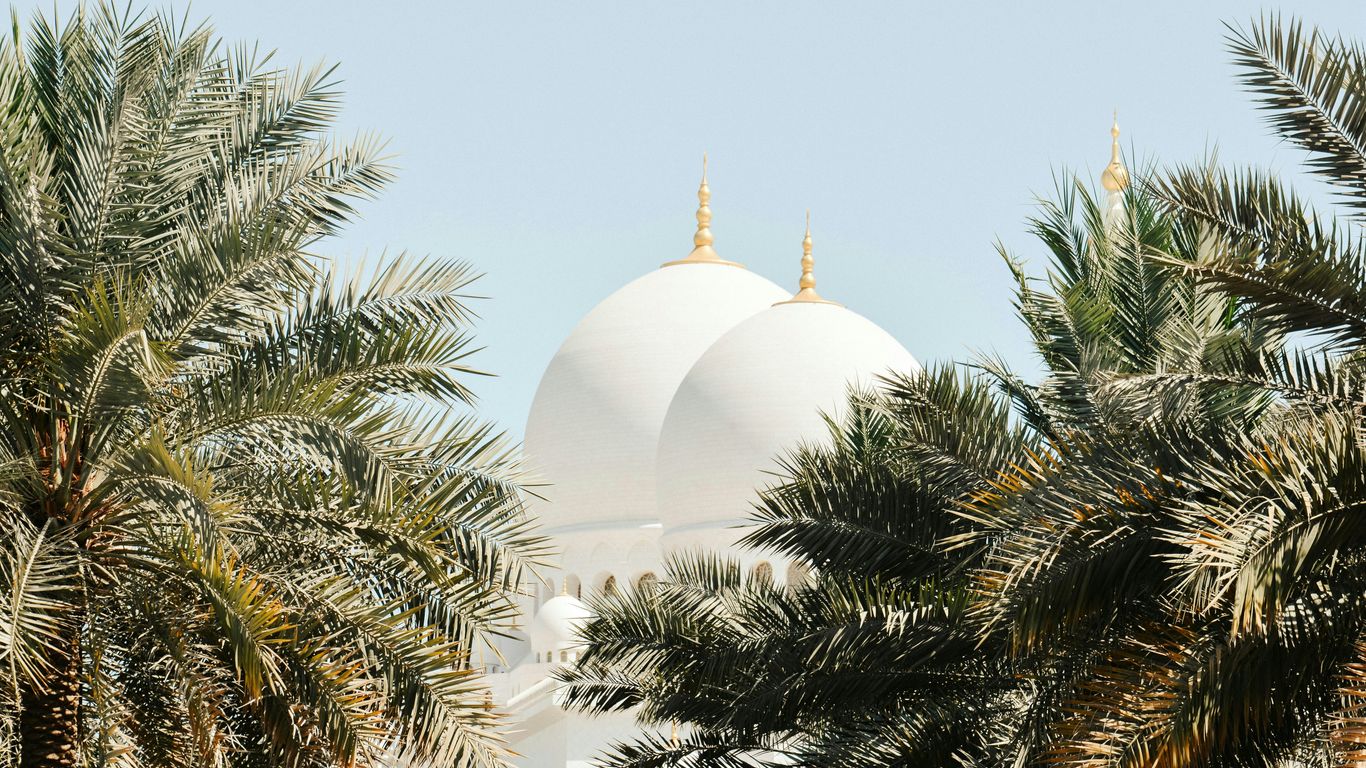
Sultan Mosque is the most recognisable religious landmark in Kampong Glam, but its meaning extends beyond the building itself. The mosque grew with the Malay royal settlement and became a place for prayer, teaching, charity and community life. Its presence helped anchor a neighbourhood in which faith was woven into work and family routines.
The mosque also gives the district a strong visual centre. Yet its significance is not simply architectural. It remains an active institution within a living community.
The first mosque and the transition to the present building
An earlier mosque served the growing settlement before the present Sultan Mosque was built in the nineteenth century. As Kampong Glam expanded, the need for a larger and more enduring place of worship became clear. The transition reflected both population growth and the continuing importance of the royal foundation.
The mosque’s development followed the changing neighbourhood around it. New buildings, businesses and families gathered nearby, making the institution part of an urban community rather than an isolated monument.
Sultan Mosque’s architecture and distinctive golden domes
The mosque is known for its large golden domes, broad prayer hall and strong visual presence along North Bridge Road. Its architecture reflects the international connections of Islam in Singapore, while its setting remains unmistakably tied to Kampong Glam’s streets. Light on the domes changes through the day, giving the building a different character from each approach.
A careful look also reveals how architecture guides movement. The mosque draws visitors towards it, but the surrounding lanes lead them back into shops, homes, eateries and other places where the district’s history continues.
Religious schools, charitable work and community gathering
Mosques in historic neighbourhoods often provide more than a prayer space. They can support teaching, family events, charitable work and practical forms of mutual aid. Around Sultan Mosque, religious life helped connect households that were also linked through trade, schooling and shared celebrations.
Such activity is less immediately visible than a dome or façade. It is nevertheless part of the building’s heritage, because institutions endure through what people do inside and around them.
How the mosque anchors Kampong Glam today
Sultan Mosque remains a reference point for worshippers, residents and visitors. It gives the neighbourhood a centre without making the surrounding streets feel frozen in time. Restaurants, textile shops and creative businesses continue to operate around it, creating a conversation between inherited uses and newer ones.
For anyone tracing living heritage stories, the mosque offers a useful starting point. It shows how a landmark can be both historic and present-tense, held in place by people who still use it.
Everyday life in the historic neighbourhood
Kampong Glam’s history is also found at eye level: a narrow staircase, a shop sign, a family recipe, a tailor’s worktable or the sound of conversation behind a doorway. Historic districts are often described through famous buildings, but their character depends on less celebrated routines. The neighbourhood was made by people working, raising children, worshipping and meeting one another.
Those routines changed with time, yet they left traces in the arrangement of shophouses and lanes. A history of Kampong Glam becomes fuller when it includes the practical lives that unfolded beside royal and commercial stories.
Shophouses, family homes and back-lane activity
Shophouses combined work and residence, often placing a business at street level and family life above or behind it. Back lanes supported deliveries, cooking, repairs and informal encounters. Space was used carefully, with several generations or kinds of activity sharing one building.
This arrangement made the street feel inhabited beyond shop hours. The line between public and private life was close, and neighbours could know one another through repeated daily contact. The everyday life of Singapore is often clearest in precisely these practical spaces.
Tailors, textile sellers, food vendors and coffee shops
Tailors and textile sellers gave Arab Street its material character, while food vendors and coffee shops provided places to pause. A customer might come for cloth and stay for conversation, or a worker might begin the day with a familiar drink before opening the shutters. These small exchanges helped turn commerce into community.
The objects of such places matter too: measuring tapes, enamel cups, handwritten orders and worn tables. They are modest evidence, but they reveal how labour and sociability shared the same rooms. Similar attention to old trades and skilled hands can illuminate heritage that official plaques tend to overlook.
Weddings, festivals and other community traditions
Weddings brought colour, preparation and extended family into the neighbourhood. Religious festivals altered the pace of the streets, with food, clothing and visits carrying meaning beyond the immediate household. Such occasions made commercial shops especially important because families needed materials, gifts and services at particular times.
Traditions also changed as families moved, businesses adapted and new generations made their own choices. Continuity does not require every detail to remain identical. It can reside in the reasons people gather and in the care given to familiar practices.
The experiences of women, children and working families
Women’s work was often spread across home, shop and community, making it easy to miss in formal accounts. Children grew up around business routines, learning by observation and helping when needed. Working families negotiated crowded space, long hours and the demands of school, worship and kinship.
Their experiences complicate any romantic picture of the old kampong. Heritage included affection and belonging, but also fatigue, limited space and economic pressure. Remembering both sides gives the district a more honest human scale.
Kampong Glam through colonial rule and post-war change
Colonial rule reorganised Singapore’s land, administration and economy, and Kampong Glam was drawn into those changes. Roads, port facilities, property arrangements and population movements affected how the district functioned. The neighbourhood remained recognisable, but its relationship with the wider city kept shifting.
After the Second World War, housing pressure and changing retail patterns placed older ways of life under strain. Some trades declined, while others adapted or moved. Conservation later gave the district renewed visibility, though not without difficult questions about whose history is being preserved.
British administration and the reshaping of the district
British administration introduced new systems of planning and control. The early division of the town into areas associated with different communities influenced how Kampong Glam was described and managed. Such categories simplified a more mixed reality, even as they shaped land use and public perception.
Colonial infrastructure brought opportunity for some and constraint for others. The district’s position near the expanding town made it commercially valuable, while official decisions could also alter access, movement and ownership.
Port expansion, migration and changing commercial patterns
As Singapore became a major port, new migrants and businesses entered the city. Goods moved faster and in greater volume, while established merchant networks adjusted to new forms of competition and regulation. Kampong Glam remained connected to trade, but its commercial role was no longer determined only by local relationships.
The port’s growth also changed the meaning of distance. Routes that once depended on personal contacts increasingly operated through companies, schedules and larger infrastructures. Behind those systems, however, families and small businesses still managed the daily work of exchange.
Post-war housing pressures and the decline of older trades
Post-war Singapore faced urgent housing needs, and older urban quarters were often judged through the lens of overcrowding and redevelopment. Families moved into new estates, and some traditional businesses lost customers or affordable premises. A quieter decline could be as significant as a dramatic demolition: when a familiar shop closes, a whole chain of knowledge may weaken.
The neighbourhood’s older trades also faced changing tastes and cheaper mass-produced goods. Some survived by specialising, while others disappeared. This was not simply a story of progress replacing the past; it was a negotiation between livelihood, space and memory.
From a lived-in quarter to a recognised heritage area
Conservation helped protect important buildings and brought public attention to Kampong Glam’s history. It also changed how the area was visited and valued. A lived-in quarter became a recognised heritage destination, with benefits for visibility and investment alongside new pressures on residents and long-standing businesses.
The strongest interpretation keeps both realities in view. Buildings matter, but so do leases, working hours, family histories and the right to use a neighbourhood without performing it for visitors.
Reading Kampong Glam in the modern city
Modern Kampong Glam holds several times at once. Restored façades stand beside contemporary signs, and a mosque, a textile shop, a café and a family home may all occupy the same short walk. The area rewards visitors who slow down enough to notice how preservation and change meet at the pavement.
A good visit is not a hunt for a perfect old Singapore. It is an exercise in reading layers: what remains, what has been adapted and what has quietly disappeared.
Conservation of shophouses and royal landmarks
Conserved shophouses preserve streetscapes, proportions and decorative details that would otherwise be difficult to recover. Royal landmarks such as the Istana Kampong Glam give the district a visible connection to its nineteenth-century political history. Together, they provide a framework for understanding change.
Conservation, though, is more than repainting façades. The meaning of a building depends on the uses and relationships around it. A shopfront becomes heritage in a deeper sense when its work, memory and community context are also acknowledged.
Haji Lane, cafés and the arrival of creative businesses
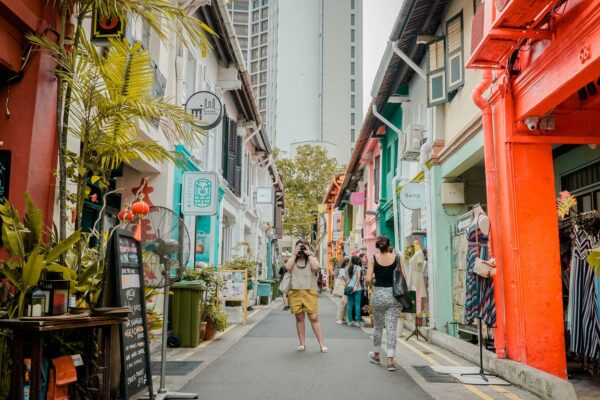
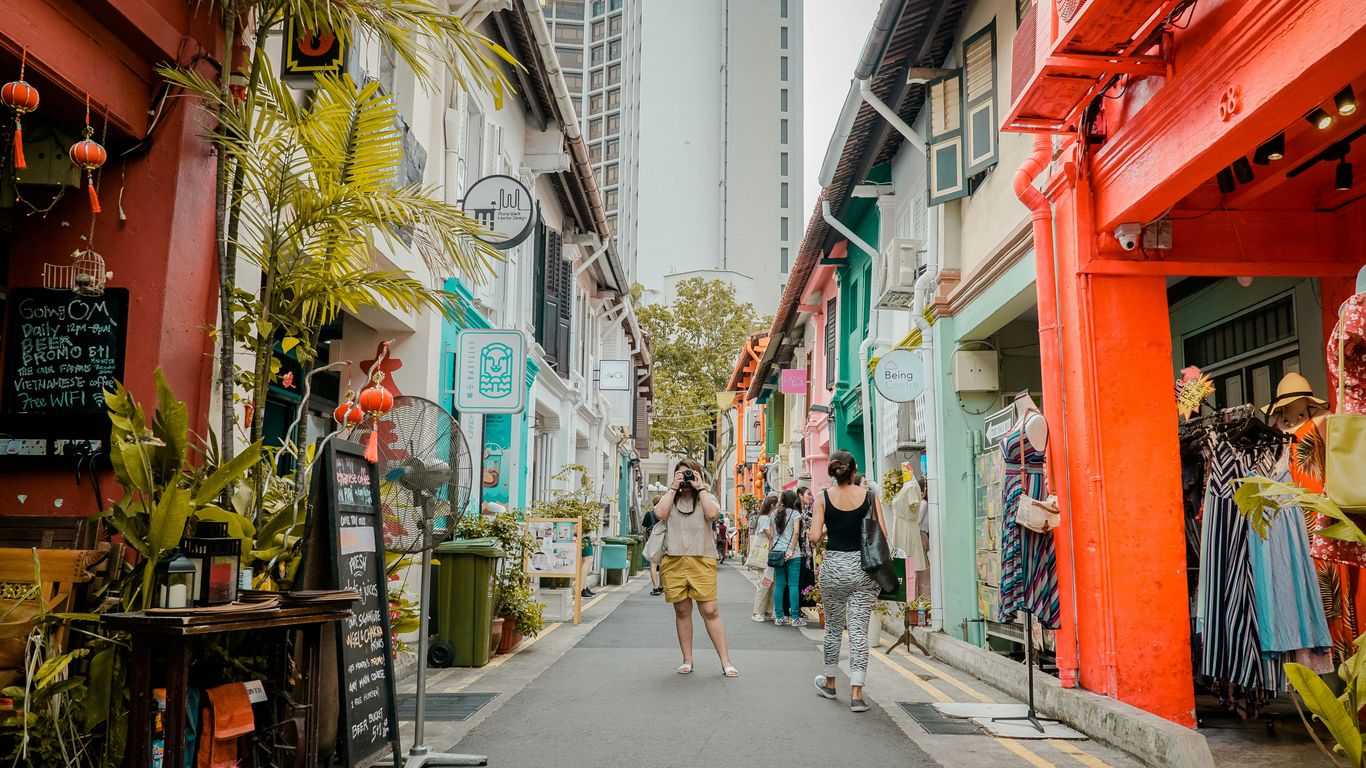
Haji Lane has become known for independent shops, cafés, bold murals and creative businesses operating within older buildings. Its popularity shows how heritage districts can attract new forms of enterprise. The visual energy is real, but it sits within a street shaped by earlier homes, trades and movement.
Visitors can enjoy the newer businesses while remembering that adaptation has always been part of urban life. The challenge is not to keep every shop unchanged, but to ensure that new activity does not erase the people and practices that made the place meaningful.
Tensions between tourism, gentrification and local identity
Tourism can support conservation and bring attention to local businesses, yet popularity may also raise rents, alter opening hours and make residents feel like spectators in their own neighbourhood. Gentrification is experienced unevenly: one business may welcome new customers while another struggles with the cost of staying.
A respectful visitor looks beyond the most photographed wall. They notice working shops, avoid blocking doorways and remember that the district is still someone’s home. That simple conduct cannot solve structural pressures, but it changes the quality of an encounter.
A walking route for understanding Kampong Glam history around Arab Street
A thoughtful walk can begin at Sultan Mosque, continue along Bussorah Street and Arab Street, and then move towards the Istana Kampong Glam before ending around Haji Lane. The route works best when it follows relationships rather than landmarks: mosque to market, royal residence to shopfront, textile trade to contemporary reuse.
For a deeper visit, book a heritage walk led by a storyteller familiar with the streets. Otherwise, the route can still be taken slowly, with attention to signs, thresholds, materials and the people using the area now. The aim is not to collect sights, but to understand how the district has carried several lives across time.
Conclusion
Kampong Glam’s history is held in the meeting of royalty, trade, faith and everyday work. Around Arab Street, the past survives not as a sealed display but as a changing neighbourhood where old buildings, active institutions and new businesses share the same ground. To walk there well is to notice both the grandeur and the ordinary care that have sustained the place.
Frequently Asked Questions
What does the name Kampong Glam mean?
“Kampong” means village, while “gelam” refers to a melaleuca tree associated with the area. The name is commonly understood as “gelam village”.
What was Kampong Glam like before 1819?
It was a coastal settlement connected to Malay maritime networks, with links to Malay, Bugis and Orang Laut communities and the wider regional trade routes.
Why is Sultan Hussein Shah important to Kampong Glam?
Sultan Hussein Shah was involved in the 1819 political settlement that allowed the British East India Company to establish a trading post. Land granted to him and his family helped establish Kampong Glam as a Malay royal seat.
Why did Arab Street become commercially important?
Its position near the royal settlement, harbour and growing town supported trade. Merchant networks dealt in textiles, spices, foodstuffs and other goods, while also supporting regional travel and pilgrimage.
What is the significance of Sultan Mosque?
Sultan Mosque developed alongside the royal settlement and became a centre for prayer, teaching, charity and community gathering. Its golden domes make it one of Kampong Glam’s most recognisable landmarks.
Is Kampong Glam still a residential neighbourhood?
Yes. Although it is also a popular heritage and dining district, homes, religious institutions, working businesses and community activities remain part of its present-day character.
How can visitors explore Kampong Glam respectfully?
Visitors can walk at an unhurried pace, respect places of worship and residential spaces, support local businesses and avoid treating the neighbourhood as a backdrop alone. Paying attention to ongoing work and community life makes the visit more meaningful.